2109 Antique Sword
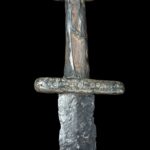
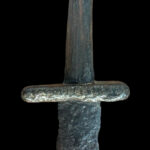
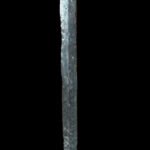
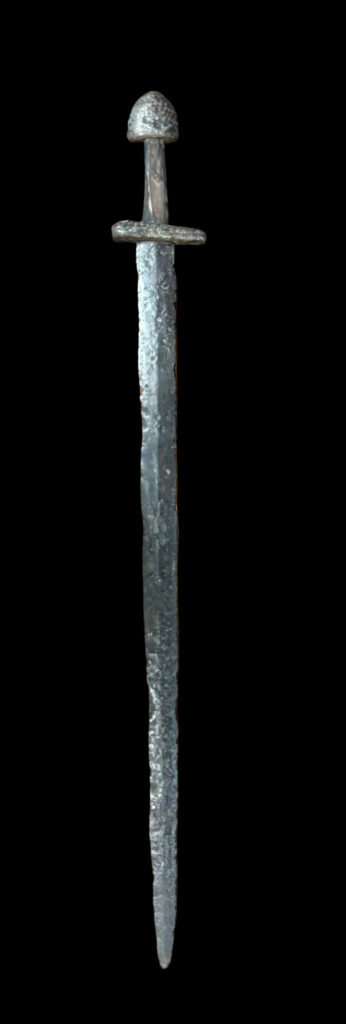
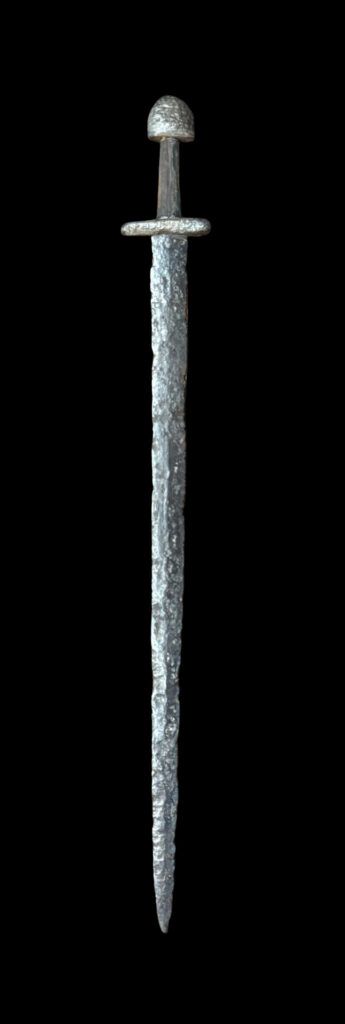
2109) RARE AND EXCEPTIONAL 9th CENTURY DECORATED SAXON SWORD WITH GRIP:
Introduction: The battles fought between the Saxons and the Vikings are legendary and span from 793–1066 AD, transforming England from a fractured group of rival kingdoms into a unified nation. Swords such as this one were the premier weapons carried by nobility and persons of wealth into these brutal shield-wall clashes.
From 793 to 865 AD, Viking military strategy centered on hit-and-run coastal raids, stealing as much as they could carry away. This changed with the arrival of a massive, coordinated Viking coalition known as the Great Heathen Army, whose new objective was the complete conquest of England. By 878 AD, all Anglo-Saxon kingdoms had fallen to the Vikings with the exception of Wessex. King Alfred of Wessex was forced into hiding in the marshes of Athelney before rallying his army.
In May 878, the Battle of Edington was fought between the West Saxon army of King Alfred and the Great Heathen Army led by the Danish warlord Guthrum. The battle took place near Edington in Wiltshire, where Alfred secured a decisive victory that halted the Viking advance into Wessex. Two weeks after the battle, under the terms of the Treaty of Wedmore, Guthrum surrendered and agreed to convert to Christianity and leave Wessex.
Discussion: Viking (Scandinavia) and Anglo-Saxon swords share much in common during the 9th century; this sword possesses diagnostic traits that heavily favor a native Anglo-Saxon rather than a Nordic Viking origin:
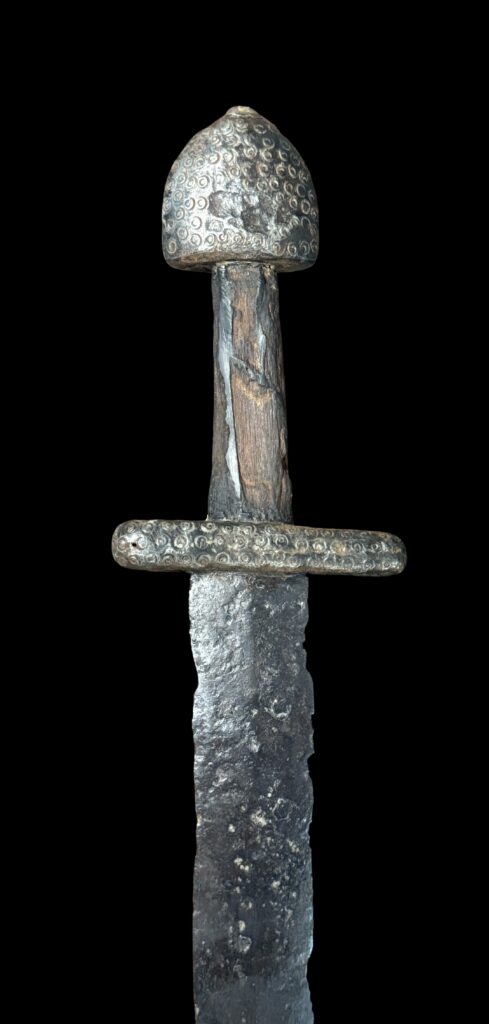
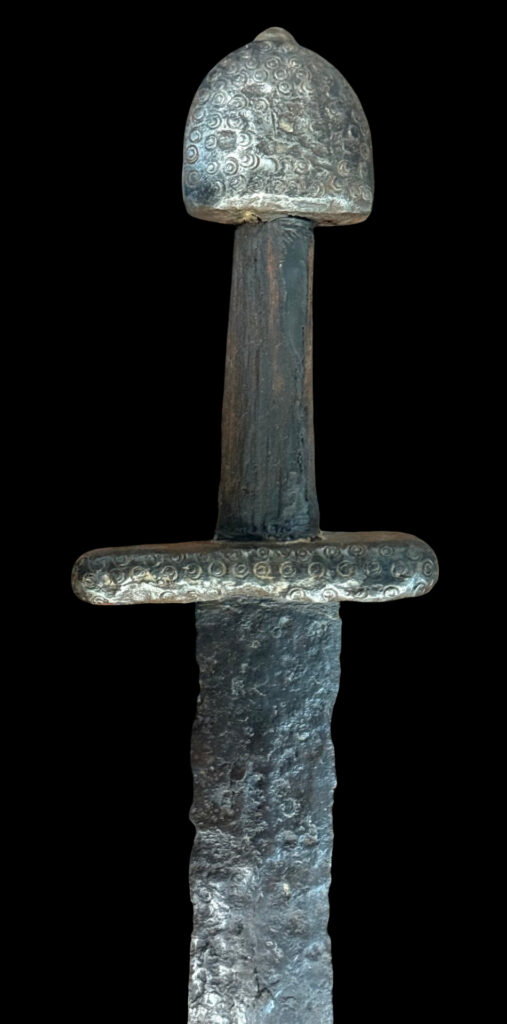
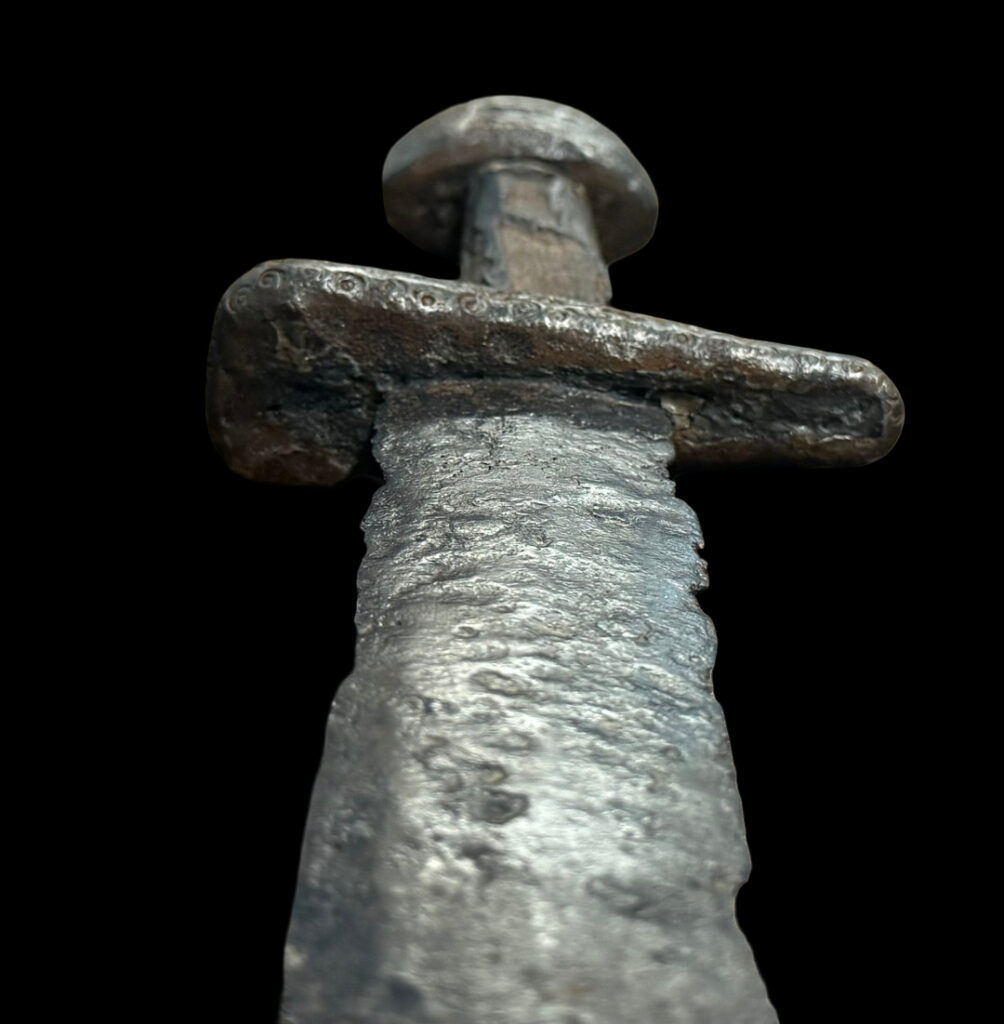
1)The defining feature of this hilt is the all-over punched concentric circle motif. While Vikings used punch-work on silver arm rings, applying dense, repeating ring-and-dot matrix stamps across the entire surface of iron or copper hilt elements is a hallmark of late Anglo-Saxon metalworking and bone/horn carving traditions. It represents a more understated, geometric Insular aesthetic compared to the fluid animal interlace of contemporary Scandinavian art styles (like Borre or Jelling).
In Sir Mortimer Wheeler’s classification of swords found in Britain, this fits into Type II. Type II swords are characterized by a simple, flat, straight crossguard paired with a semi-circular or roughly triangular pommel. They are native developments or heavily influenced by Frankish styles, favoring clean geometric proportions. Conversely, the classic Scandinavian hilts of the 9th century (such as Petersen Type H, D, or E) are famously heavy, blocky, and complex. They usually feature massive, multi-lobed pommels (often divided into 3 or 5 distinct segments) bound by twisted wire or deep, high-relief cast bronze animal art.
2) The guard is in the shape of an isosceles triangle, which is not a Viking guard found in Petersen or Wheeler’s classification of Scandinavian swords.
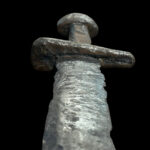
Description: Constructed of early medieval iron, with a broad, double-edged blade showing historical pitting and corrosion as you would expect from a museum-quality sword from the 9th-10th century. The hilt features an isosceles triangle crossguard and a semicircular, “cocked-hat” style pommel. Both the pommel and crossguard are decorated en suite in a dense, meticulously punched decoration consisting of repeating concentric circles (ring-and-dot motif). The grip preserves remnants of an organic wood handle core.
Condition: Very good for such an early sword.
Approximate length:
Provenance: A fine European collection.
Conclusion: Saxon swords are much rarer than Viking swords. The Vikings traveled where others did not. They traveled to the Black and Caspian Seas via rivers. Their trade route to Iran was via Sweden. The Vikings were so nomadic that they are credited with helping establish the Kingdom of Kiev (Kyiv) in 864 AD, which is the nucleus from which Medieval Russia grew. As a result, swords are found throughout all parts of Western, Central, and Eastern Europe. Saxon swords are generally confined to Western England.
All arms and armor collectors should own an early medieval sword, and all Viking collectors should own a Saxon sword. Saxon swords are seldom available in the collectors’ market, so this is a rare opportunity. ACT-NOW!!!*
All my items come with the following:
–Free shipping.
–10-day review period.
–Certificate of Authenticity.
–Autographed copy of my book.
–In the event of an international shipment, we will help assign the lowest correct Customs tariff so you pay the least.