2096 Antique Sword
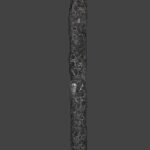
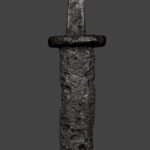
2096) AN EXCEPTIONAL VIKING PERIOD RITUALLY KILLED SWORD:
Introduction: Deliberately bending, twisting, or breaking a sword before burial is one of the more intriguing practices associated with Iron Age and Viking Age weapon burials. Archaeologists often describe such weapons as “ritually killed” because they appear to have been deliberately rendered unusable before being deposited with the dead.
Deliberate weapon destruction is well documented in northern European burial traditions, but the precise meaning of the act remains uncertain.
First, destroying a weapon could discourage its reuse. A sword with a severely bent or twisted blade could not be used effectively without repair. The destruction might have represented a deliberate sacrifice of valuable property rather than merely disposing of an unwanted object.
Second, grave robbing is not necessarily the main explanation. Archaeologists have documented grave reopening and disturbance in Viking Age Scandinavia. However, a destroyed sword could still have been valuable for its fittings or scrap metal, and some damaged blades could be repaired by a skilled smith. The claim that a bent sword was effectively worthless, or that its destruction made a burial economically unviable to loot, is too strong.
The destruction may have helped prevent reuse or made grave robbery less attractive. But there is no firm evidence that deterring looters was the practice’s universal, or even primary, purpose.
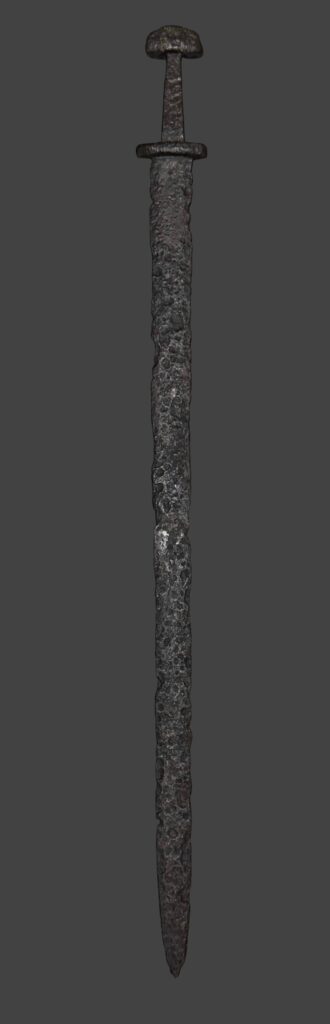
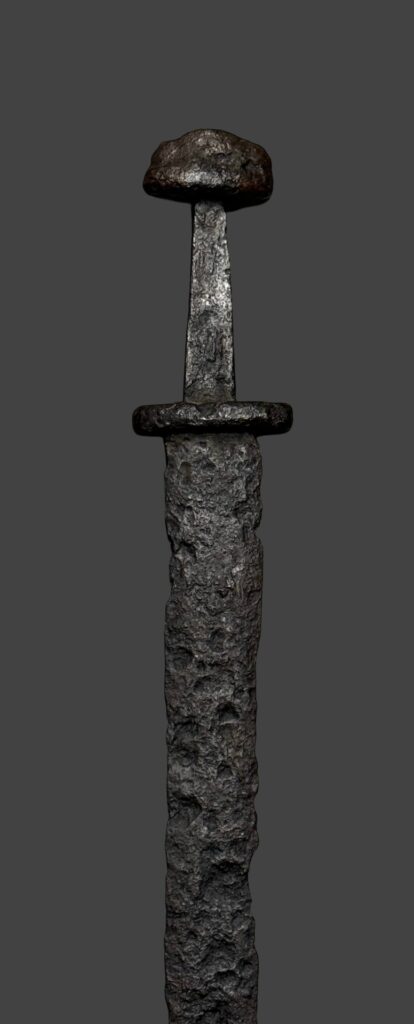
Description: Constructed with a prominent tri-lobed cap characteristic of the mid-to-late Viking Age (roughly 9th–10th century). It sits securely on an upper guard, typical of Petersen Typology Type H, I, or early variations of Type S. The lower crossguard and upper guard are short, thick, and oval. The grip area shows a bare, flat, tapered iron tang where organic materials—like wood, bone, or horn wrapped in leather or silver wire—would have originally rested before decaying over centuries of burial.
Approximate length: 38 inches.
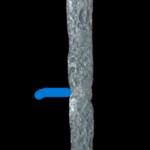
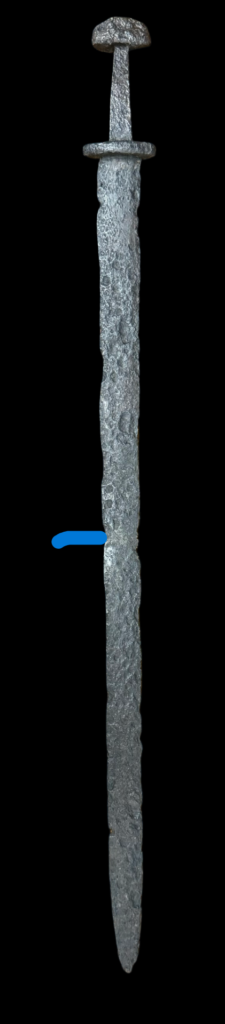
Condition: The sword has been conserved to museum standards. As expected, the steel surface is pitted. This suggests it spent centuries submerged in an anaerobic or semi-waterlogged environment, where the iron slowly oxidizes. The blade was straightened and reattached, as indicated in blue; a bend at the base of the guard was also corrected. The dark, loose rust scales have been completely stripped away, and the iron has been treated with a protective sealant or microcrystalline wax to give it a clean, matte gray finish. This highlights the sword’s raw form while preventing future degradation.
Discussion: Culture strongly suggests that weapons held significance beyond their practical function, though surviving Norse texts do not directly establish the idea that a sword possessed a separable spirit that had to be killed.
In Viking Age Scandinavia, swords could represent far more than tools of combat. They might embody family inheritance, personal reputation, social rank, wealth, and a warrior’s identity. Some famous swords even had individual names.
The Old Norse literary tradition preserves examples of swords with remarkable personalities and histories. In the Volsunga saga, for example, the sword Gram is a central element in the story of Sigurd.
The deposition of weapons in graves suggests that weapons had an important role in how the living commemorated the dead. But there are several possible explanations for why a blade was damaged:
- Ritual transformation: The weapon may have been symbolically withdrawn from the world of the living and transferred to the deceased.
- A funerary offering: Destroying the weapon might have made the offering permanent, demonstrating that it was no longer intended for ordinary use.
- A display of status: Sacrificing a valuable sword could demonstrate the deceased’s and their family’s wealth, power, or prestige.
A broader interpretation of Norse funerary beliefs allows a connection to Valhalla and Fólkvangr, but no clear surviving Viking Age source states that a sword had to be physically killed so its spiritual counterpart could accompany its owner.
A broken sword might have been an offering to the dead, a symbol of final separation from the living, or a means of demonstrating that the weapon was being permanently removed from circulation.
Viking Age swords were expensive, prestigious objects. A high-quality sword required skilled metalworkers, substantial quantities of iron and steel, and considerable labor. Some blades were imported from workshops in continental Europe and could carry distinctive inscriptions or pattern-welded construction.
Provenance: A European collection started after WWII.
Conclusion: The stories this sword could tell.
Who was the Viking buried with it?
Did he win it in battle?
How many battles did this sword participate in?
If you’re looking for the ultimate conversation piece, this is it.
ACT NOW: ritually killed swords rarely make it to market.
Priced to sell today for a lot less than you expect!!!*
All my items come with the following:
–Free shipping.
–10-day review period.
–Certificate of Authenticity.
–Autographed copy of my book.
–In the event of an international shipment, we will help assign the lowest correct Customs tariff, so you pay the least.
I believe you will be very pleased. ACT-NOW!!!*