2040 Antique Sword
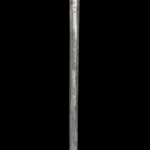
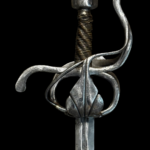
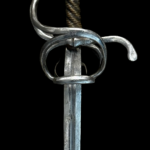
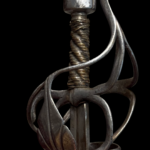
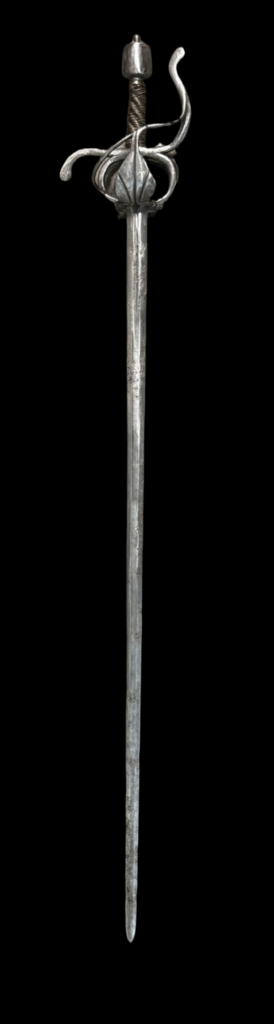
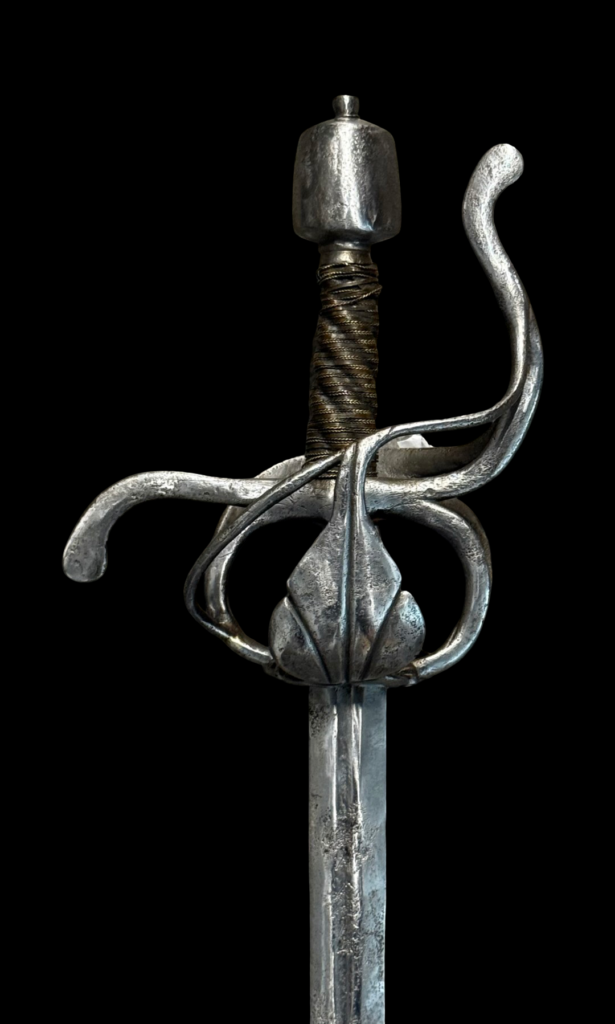
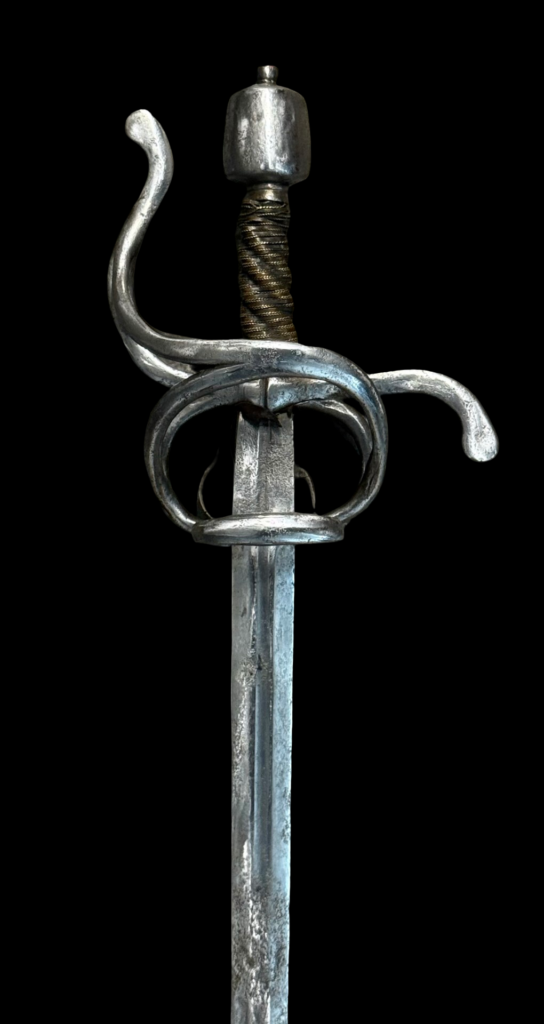
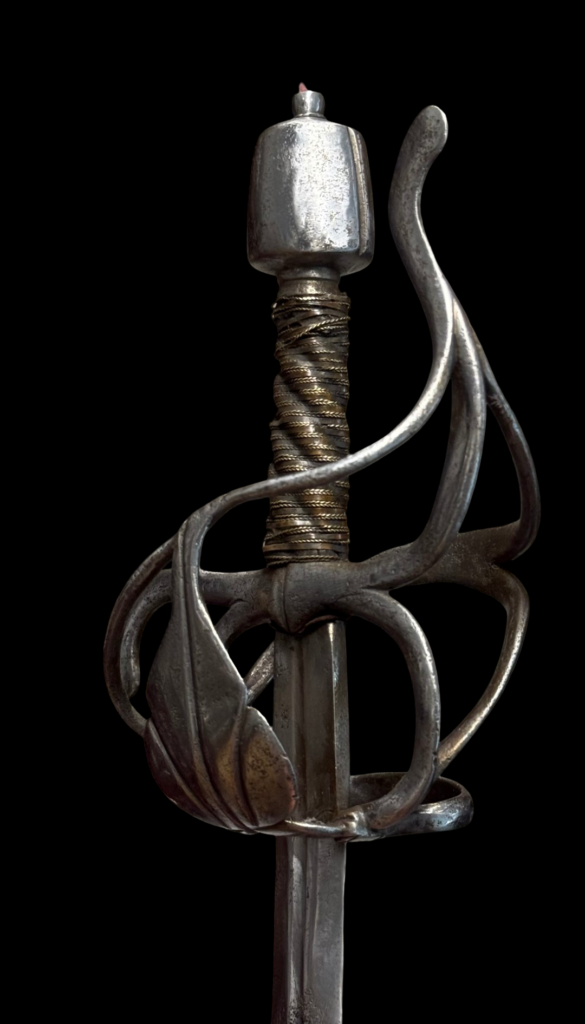
2040) German Swept-Hilt Rapier With A Distinctive Shell Guard, Circa 1600:
Introduction: The owner says, “Price it extra-low so you can sell it today”. The earliest illustration of this sword type is in a 1588 portrait of John Shirley, currently housed in the Metropolitan Museum of Art (#51.194.2). Also illustrated in a 1585 portrait of Luccio Foppa by Giovanni Figino.
Description: The sword under discussion is a Norman type 57. Constructed with a long, slender, and stiff design, designed primarily for thrusting. It has a single narrow, short fuller extending down the first quarter of the blade length, starting at the quillon block, with a rectangular ricasso. A complex, asymmetric iron swept-hilt configuration. The guard consists of multiple curved bars designed to protect the user’s hand, including a swept hilt and a finely chiseled acanthus- or shell-like leaf decoration integrated into the guard’s structural loops. A tightly wrapped, twisted wire grip, a heavy, barrel-shaped pommel capped with a small peen.
Condition: Good, has some signs of pitting on the blade. Conserved to museum standards.
Approximate length: 43 inches.
Discussion: A highly expensive and ornate rapier such as this one was the equivalent of a person in our day and age making a fashion or opulence statement by wearing very expensive jewelry, such as a Rolex or Audemars Piguet watch. High fashion was an essential symbol of status and power in the late Middle Ages and the Renaissance. High fashion was especially important among the mega-wealthy, who wanted to outdo their rivals, neighbors, and peers in the fashion arena. Not all wars were fought on the battlefield with swords, lances, and armor. A non-bloody war was in the fashion and status arena. Fashion also extended deeply to Arms and Armor. The phrase… “keeping up with the Joneses” … is not a new 20th-century concept.
In an era lacking effective policing, the private citizen was forced to protect himself from society’s criminal dregs. The weapon of choice was the rapier from the mid-16th to the late 17th century. The rapier is a simple yet highly effective sword against non-armored opponents. The rapier was primarily a thrusting weapon that could inflict serious injury to an adversary’s vital organs with minimal effort. It was also an exceptional slashing and cutting weapon; however, the slash was less lethal than the thrust. The slash was used more as a feint to set up a finishing thrust. The slash was also a dire warning to a would-be assailant of the horrors to quickly follow if he chose not to acquiesce.
Because fencing is more of a thrusting art, it became commonplace throughout Europe to have as long a blade as possible to obtain an advantage. This extravagance in length reached the point that municipalities passed statutes regarding the allowable lengths of blades. Those in violation had the misfortune of having their rapier‚ blades cropped at the tip at the city gate to comply. One example of these statutes is the English Royal Proclamation of March 17, 1557. The French adopted the phrase “espee rapiere” by 1475, which was later shortened to simply “rapiere.” The English, in 1505, spelled it”rappyer.” The Giles Duwes English/ French dictionary of 1532/3 adopted the rapier definition as “Spannyshe sworde”.
Conclusion: Even if you are not a rapier aficionado, all early arms and armor collections should have at least one example of a rapier. Military rapiers have a strong attraction for collectors.
ACT NOW to get the lowest possible price and avoid disappointment. This one should sell fast.
All my items come with the following:
–Free shipping.
–10-day review period.
–Certificate of Authenticity.
–Autographed copy of my book.