2033 Medieval Sword
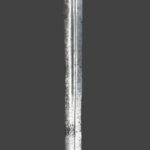
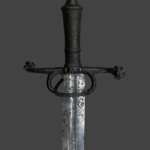
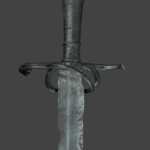
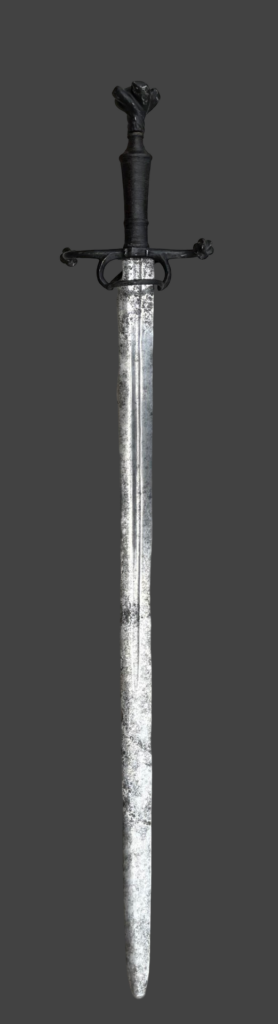
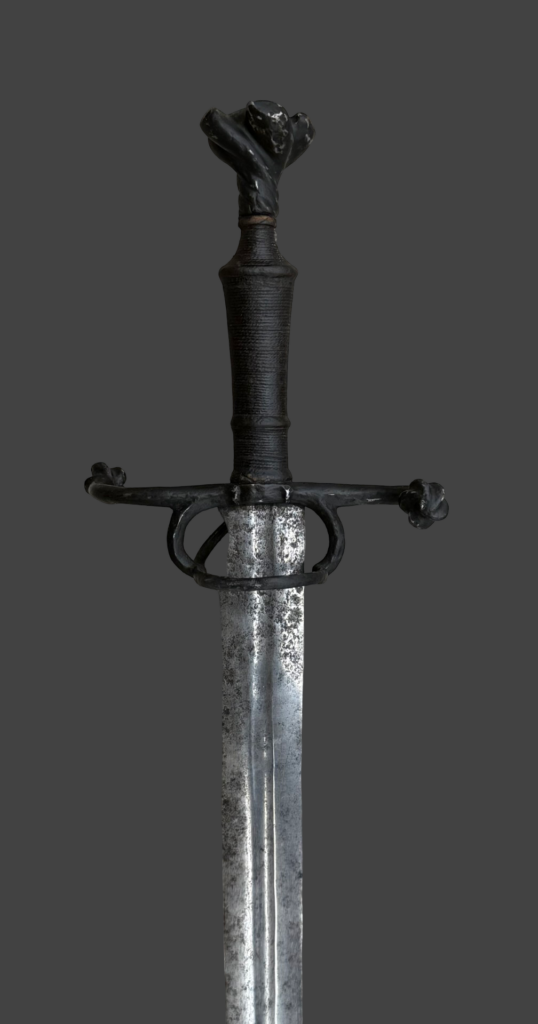
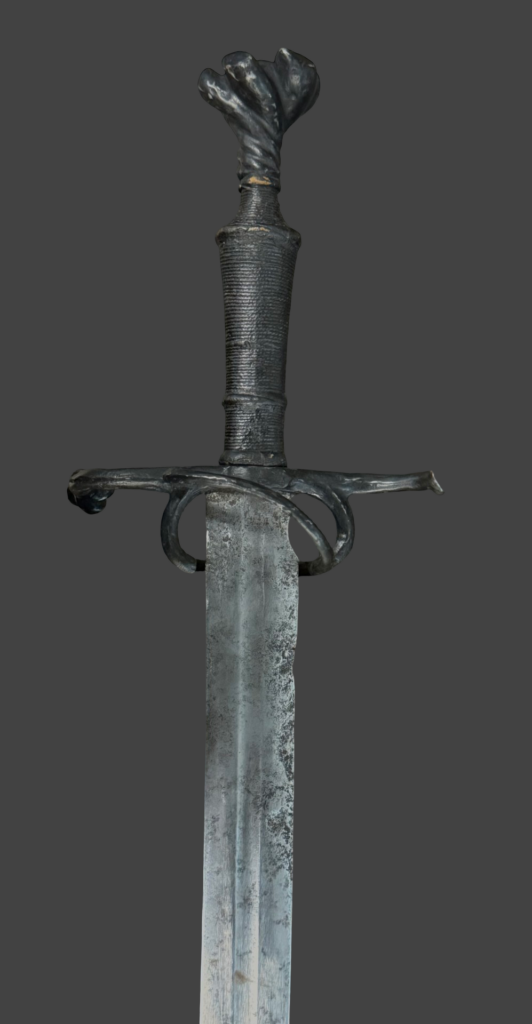
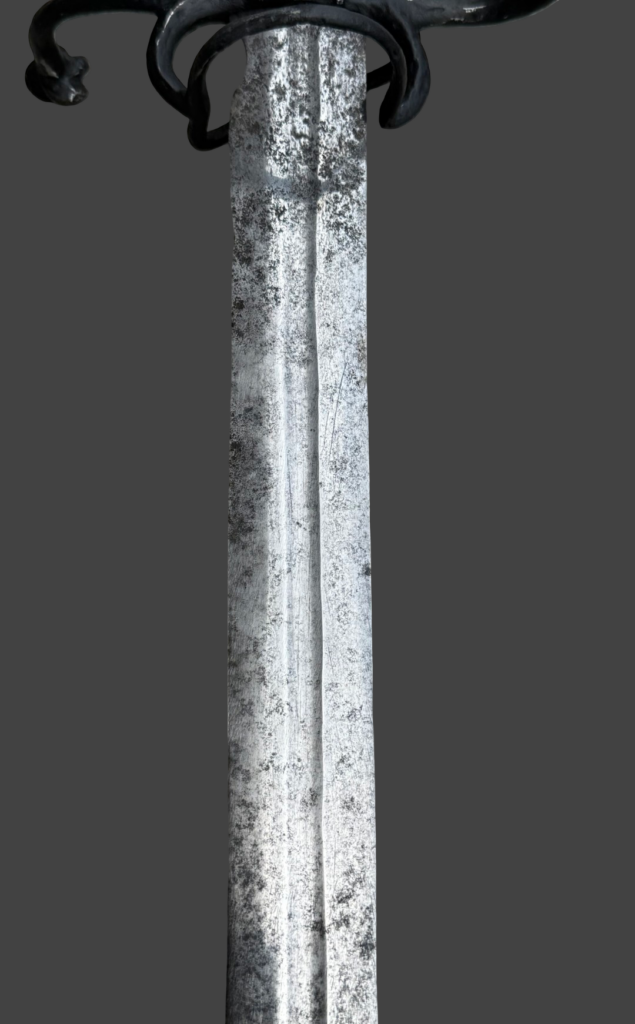
2033) MAXIMILIAN BASTARD WAR SWORD CIRCA 1520 WITH MAKER’S MARK: This is a true bastard sword that can be wielded with one or two hands. The spirally fluted hilt on this sword is most indicative of the Maximilian fashion.
Introduction: In the early 16th century (up to about 1535), the well-dressed, wealthy, or Noble Knight was wearing Maximilian armor. Emperor Maximilian I started an armory in Innsbruck from 1504 to circa 1650. The purpose of the armory was twofold:
(1) To produce exceptional armor for the emperor and his court.
(2) To manufacture munitions-grade armor for Maximilian’s imperial army.
Little did he know at the time he was creating the most sought armor by collectors hundreds of years later.
— During the first 35 years of the century, fluted armor evolved, which the Victorians referred to as Maximilian armor. The Maximilian fashion was originally an early 1505 Innsbruck reproduction of the contemporary pleating fashion found in close-fitting civilian jackets (doublets). Early breastplates in this fashion were embossed with only a few decorations (see page 132 in my book).
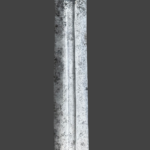
Description: This sword’s construction consists of a two-sided blade of flattened hexagonal shape with a slight fuller about 2/3 the length of the blade, the blade slowly tapers to a rounded tip. A broad and handsome reverse conical fluted pommel (striation on one of the flutes) with a finial button at its apex. It has a classic anatomical two-stage hock bottle wooden grip. It tapers slightly towards the pommel and is tightly wrapped in black cord or cord-bound leather, providing a secure, high-friction texture for either one- or two-handed use. The iron crossguard is horizontally straight but develops a subtle forward and backward “S-curve” plane near the tips, terminating in tightly scrolled, knobbed finials that mirror the design of the pommel. Affixed directly to the center of the crossguard are two protective side rings. These metal loops form a rudimentary basket hilt, designed specifically to protect the wielder’s knuckles and fingers from sliding enemy blades during close-quarters binding or thrusting.
Approximate dimensions: Total length 40.5 inches.
Condition: The metal shows historical aging, consistent with centuries of preservation.
Provenance: Obtained from a European collector via his 3rd party representative.
Discussion: A bastard (or hand and a half sword as later called by Victorian collectors or Anderthalbhander in German) is a combination of a short two-handed sword that can be wielded like a one-handed sword. It cuts and thrusts with a broad or long double-edged blade. Additional power can be employed by using (A) the pommel and the related lower area of the hilt below the pommel as a grip for a two-handed strike in order to increase impact and penetration. Actual period bastard swords are rare.
The term bastard sword is first recorded in France during a duel in the 17th century. In Marc de Vulson’s 17th-century treatise “Vray Theatre d’Honneur”, he describes the weapons used in a duel fought before King Henry II of France in 1549 as follows: Deux epees batardes pouvant servir a une main ou a deux (Two bastard swords that can be used with one hand or two). I prefer the term “bastard sword” since this is the original term and not one concocted by the Victorians. It’s interesting to note that the ballock dagger (a vulgar word for testicles) was renamed the kidney dagger around the same time. They first appeared circa 1250 until circa 1650. They were widely used in Germany and Switzerland, but more prevalent towards the end with the Central European Cavalry.
Hilts varied throughout their evolution. Until circa 1550, most hilts on German bastard swords were cruciform in shape, with some having S-shaped guards. After circa 1550, some hilts became more elaborate. From approximately 1550, Swiss bastard sword hilts featured recurved quillons, knuckle guards, and ring guards. Blades were slightly curved, having developed somewhat from the Swiss saber (Schweizersabel). Prior to c1250 and the development of the bastard sword, swords were designed as arming swords with their use limited to one-handed use. Since they were knightly weapons, they were frequently used from horseback.
Sword length during this period varied from approximately 35 to 40 inches; after c1250, length increased to approximately 45 to 55 inches. So why did it take until the early 1300s for the bastard sword to flourish?
Primarily, there are two significant reasons:
1) For the same reason, full metal defensive armor and two-handed swords did not develop until the same period. As furnaces grew larger in medieval Europe, billets of steel —solid lengths of steel —increased in size accordingly. With bigger billets, swords could now be made with fewer (but larger) billets of steel. Eventually reaching the apex of one billet per sword. Larger furnaces generally meant higher temperatures, better steel, faster production, and probably lower manufacturing costs on a large scale.
2) As the master armorer evolved defensive armor, his counterpart, the swordsmith, did the same with larger and more specialized swords of superior quality and design. This was the weapons race of its day.
Conclusion: This is a rare opportunity to own an important piece of Medieval/Renaissance military history. This sword sits squarely in the transitional period between Gothic and Renaissance swordmaking — likely South German or Swiss in origin. The rosette quillon terminals and finger rings reflect evolving fencing techniques of the era, coinciding with the published fighting manuals (Fechtbücher) by masters such as Hans Talhoffer and Joachim Meyer.
Swords like this seldom make it to the collectors’ market. ACT NOW!!!*
All my items come with the following:
–Free shipping.
–10-day review period.
–Certificate of Authenticity.
–Autographed copy of my book.
– In the event of an international shipment, we will help assign the lowest correct Customs tariff so you pay the least.