
2028 Axe
2028) RARE HIGHLY DECORATED EXECUTIONERS AXE DATED 1647:
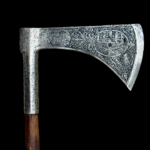
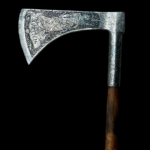
Introduction: For the collector looking for the ultimate conversation piece. A professional executioner’s axe, enabling a powerful two-handed downward strike with maximum control while standing upright. Both faces of the blade are covered entirely in fine chiseled or acid-etched engraving of exceptional quality and density, indicating commission by a civic or noble authority rather than a working field implement. The blade profile is characteristic of Central European judicial axes of the mid-17th century, with a gently curved cutting edge and a squared poll opposite.
The date 1647 places this object in the final year of the Thirty Years’ War (1618–1648), a period of intense legal and political activity across Central Europe. Civic authorities frequently commissioned new judicial instruments during this period to reassert their legal sovereignty. The quality of construction strongly suggests this axe was a prestige commission, as much a ceremonial object as a functional implement — intended to be displayed, processed, and witnessed as a symbol of state power at the moment of execution.
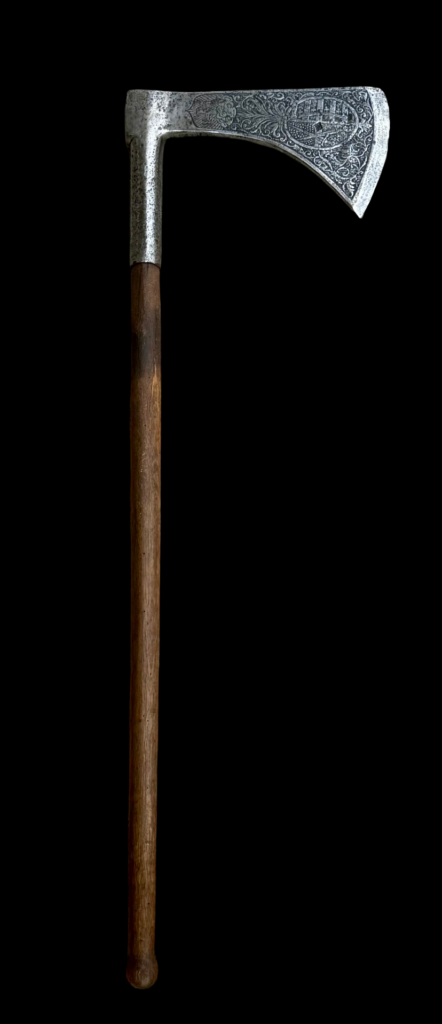
Description: Constructed with a haft that terminates in a distinctive rounded knob or pommel at the base, a period-correct functional feature that prevented the handle from slipping during the swing, and assessed as original to the piece, with some worm holes. The hardwood displays a rich, dark-brown patina consistent with genuine age and is either original to the 1647 commission or a period replacement.
A large, single-bitted executioner’s axe with a broad, fan-shaped blade rising from a robust hand-forged iron socket. The head is secured to the haft via an integrally forged socket — a construction method typical of professional-quality German smithwork of the period. The blade head is set at approximately 90 degrees to the haft axis, the classic configuration for a controlled downward execution stroke over a kneeling condemned person.
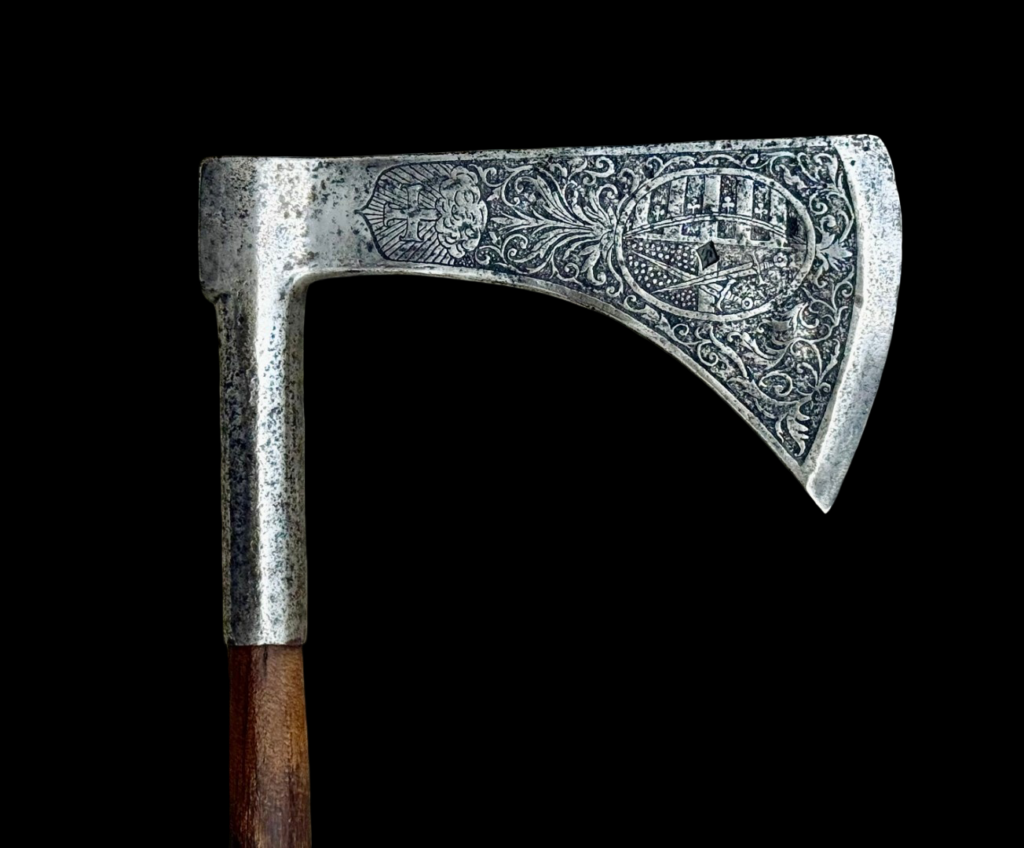
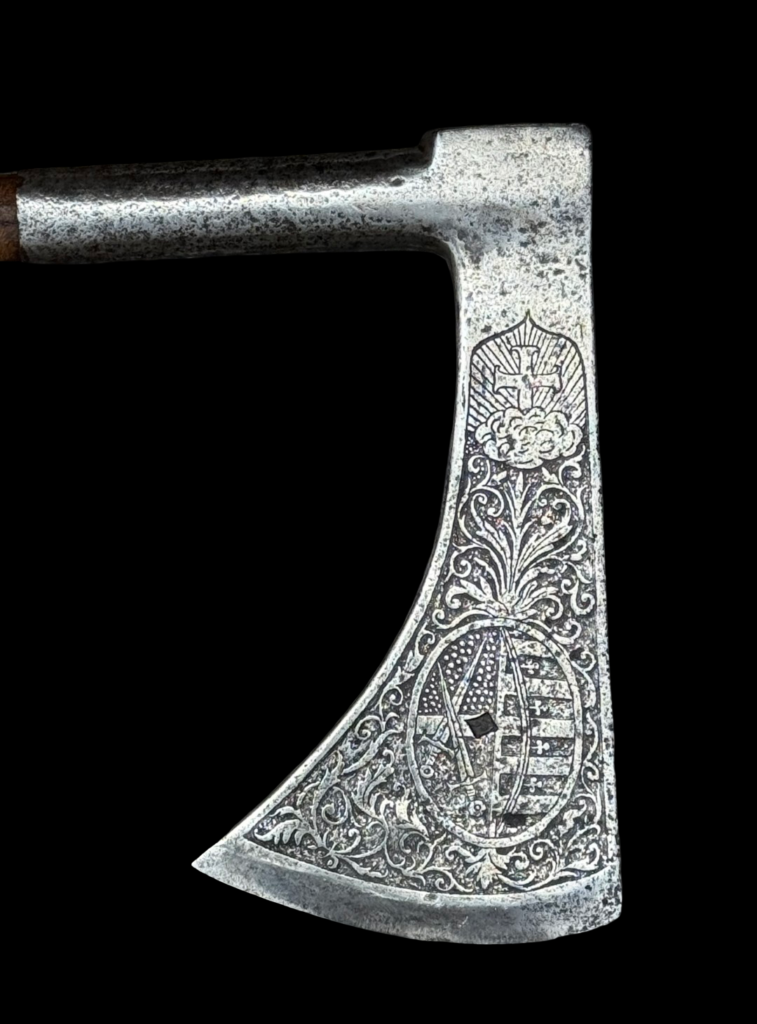
The obverse face is decorated in the High Baroque style, with dense, interlocking acanthus-scroll arabesques filling the entire surface of the blade. The scrollwork is executed with great confidence and fluency, consistent with a professional armorer-engraver working in the German tradition.
Prominent near the poll is a large naturalistic flower — most likely a tulip — rendered with botanical precision. This motif was widespread in European decorative arts of the 1640s–50s, coinciding with the height of pan-European tulip iconography. The floral element is framed by asymmetric foliate tendrils that flow across the face of the blade.
At the center of the composition is a heraldic cartouche or shield device filled with hatched and diaper-pattern engraving, surrounded by scrollwork. This shield almost certainly represents the coat of arms or civic emblem of the town or jurisdiction that commissioned the axe — a common practice confirming the instrument’s status as official state property. Additional fine linear details and dotted groundwork fill remaining spaces, demonstrating mastery of the goldsmith-engraver’s technique.
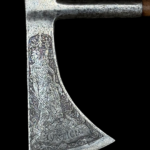
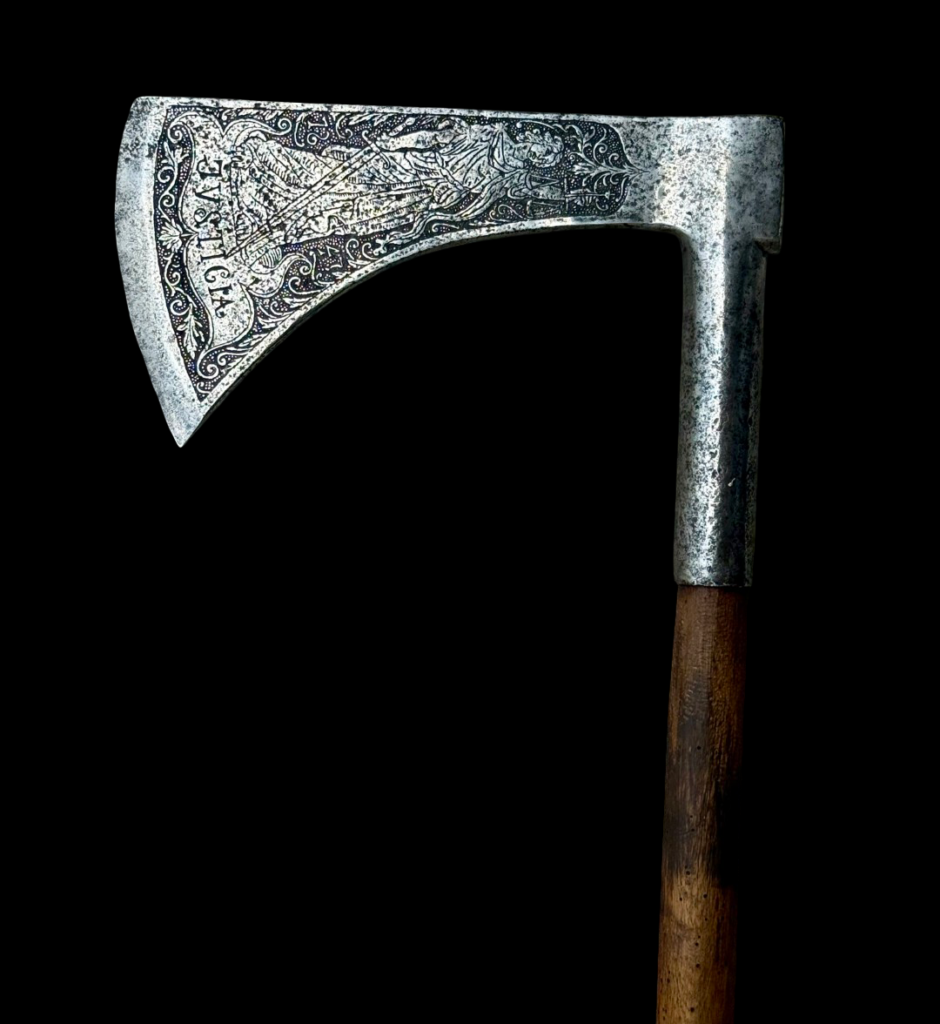
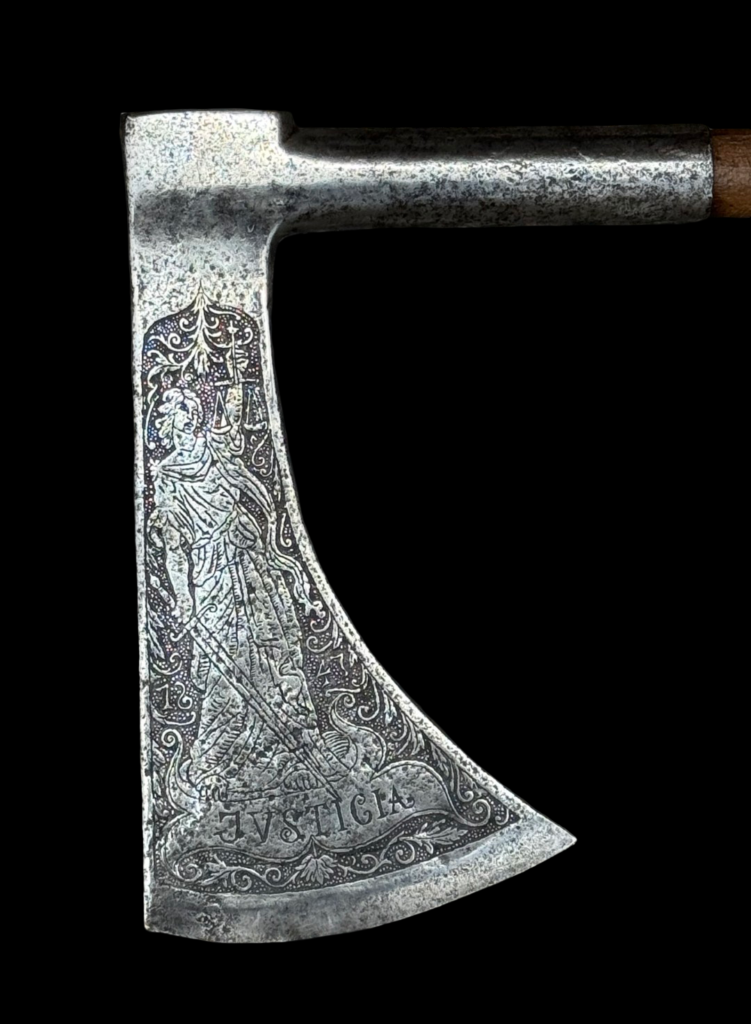
The reverse face carries the Latin inscription IUSTITIA — “Justice” — engraved in bold, well-formed capital letters across the upper portion of the blade. This inscription is the defining iconographic statement of the object: it declares that any execution carried out with this axe was an act of lawful justice, not personal violence. The inclusion of IUSTITIA on judicial weapons was standard practice in Central European jurisdictions and is corroborated by museum examples, including the Cleveland Museum of Art’s 17th-century German executioner’s sword.
Below the inscription, the reverse face features a complex figural composition set within the same dense Baroque scrollwork that characterizes the obverse. The central imagery includes a large bird — almost certainly an eagle — rendered with spread wings or in a heraldic pose. The eagle was the preeminent symbol of imperial and civic authority across the Holy Roman Empire and its constituent states, and its presence here reinforces the jurisdictional and state authority expressed by the IUSTITIA inscription.
Flanking and below the eagle are large palm fronds or laurel branches — classical symbols of victory, righteousness, and divine sanction frequently employed in judicial and funerary imagery of the period. At the base of the composition, near the socket, a further decorative cartouche with foliate infill anchors the design. The combined imagery of eagle, laurel, and Justice constitutes a complete visual statement of state-sanctioned authority.
Dimensions: Length: 43 inches, width 13 inches.
Condition: Superb.
Discussion: Contrary to popular belief, most executioners’ axes were not used for decapitation as often as you may think. Some executioners’ axes were used as symbols of justice, signifying a powerful individual, such as a Noble, a judge, or an appointed authority figure. The axe was a visual reference for the masses who still could not read or write.
Obverse — Identity & Authority: The heraldic shield device identifies the commissioning jurisdiction. The dense scrollwork and tulip imagery communicate civic wealth, sophistication, and the Baroque aesthetic values of the mid-17th century.
Reverse — Moral & Legal Justification: IUSTITIA, the eagle, and the laurel together assert that the executions performed with this instrument are divinely sanctioned, legally authorized, and morally righteous. This was essential in an era when the executioner occupied an ambiguous social role — officially empowered yet personally stigmatized.
COMPARABLES & LITERATURE
Comparable decorated Central European executioners’ weapons from the mid-17th century are held in the collections of the Cleveland Museum of Art (executioner’s sword, German, 17th c.), the Royal Armories, Leeds, and the Germanisches Nationalmuseum, Nuremberg. The iconographic formula of IUSTITIA combined with imperial eagle and laurel on a judicial weapon is well documented in German-speaking jurisdictions of the Holy Roman Empire, c. 1600–1700.
Conclusion: A rare collectible that could augment any collection and invoke the phrase “If only it could speak, what stories would this ax tell? “
This is an item for the collector who wants the ultimate conversation piece.
ACT NOW or be disappointed. I have no idea when and if I’ll get another one this exceptional.
ACT NOW to get the lowest possible price and avoid disappointment. This one should sell fast.
Contact Me Now To Get The Lowest Price Possible From The Owner!!!*
All my items come with the following:
–Free shipping.
–10-day review period.
–Certificate of Authenticity.
–Autographed copy of my book.
– In the event of an international shipment, we will help assign the lowest correct Customs tariff so you pay the least.