1969 Antique Armor
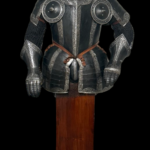
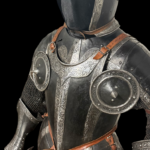
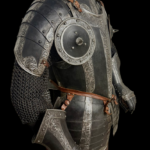
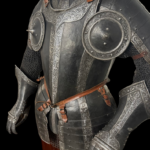
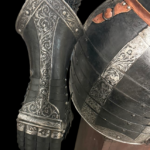

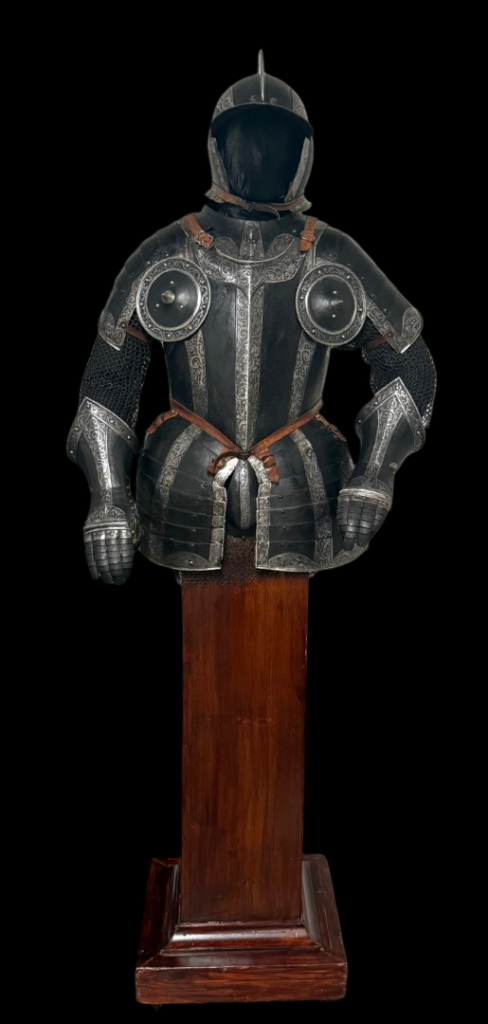
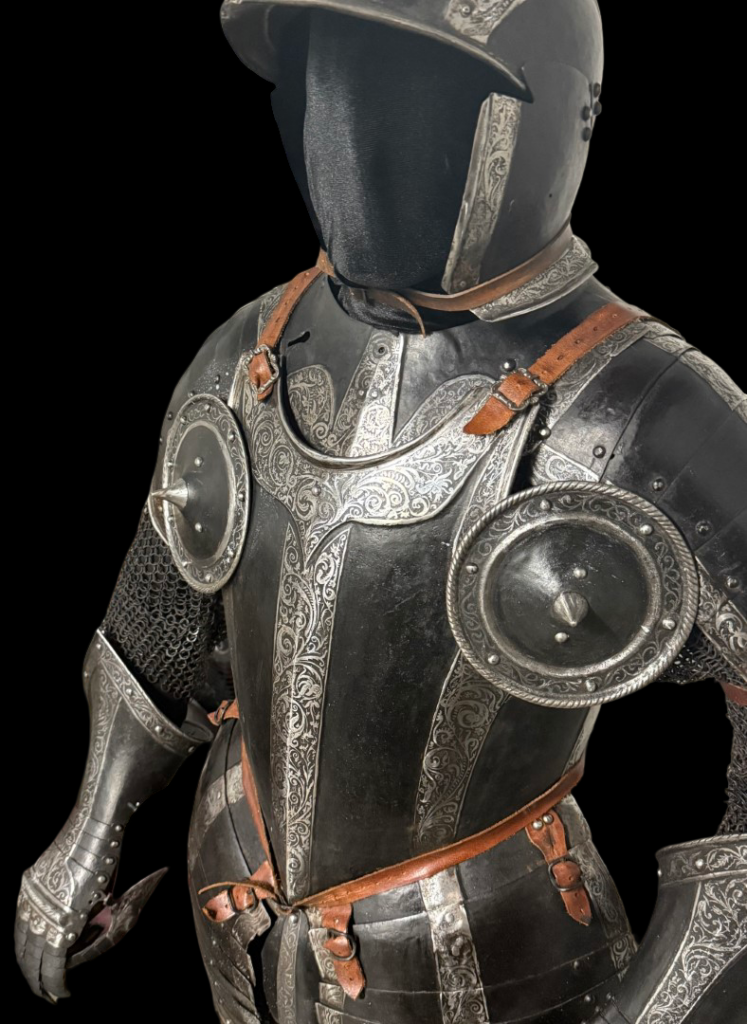
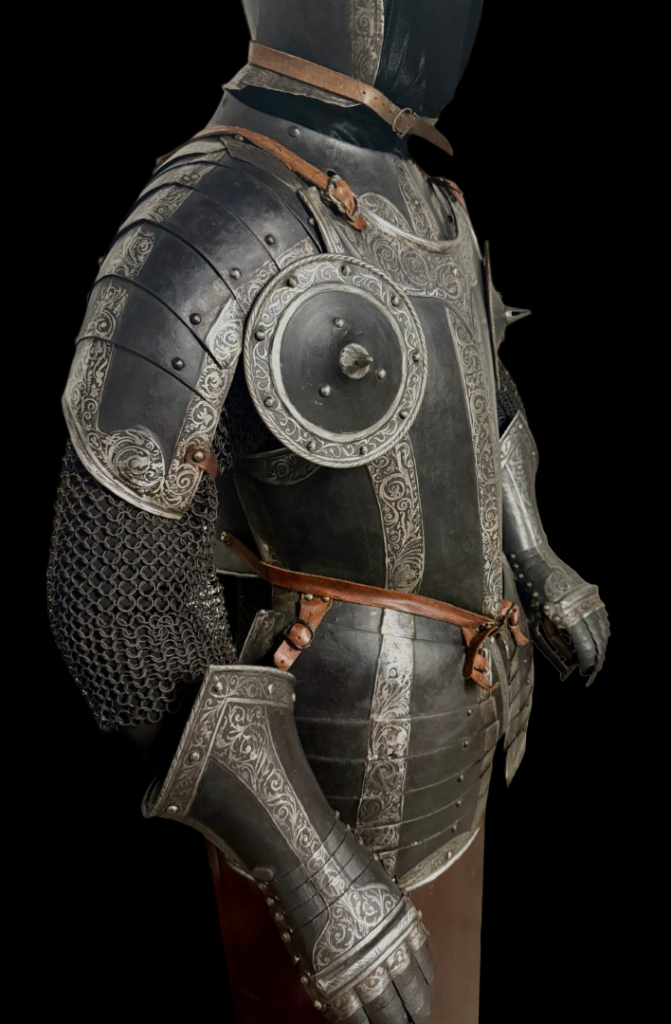
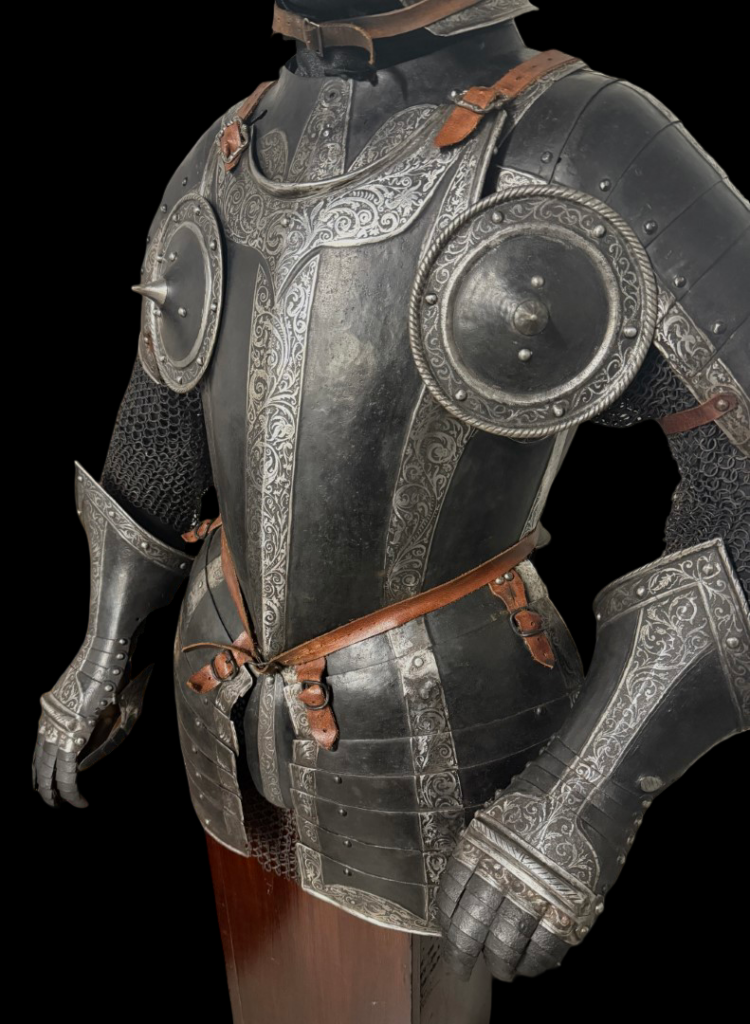
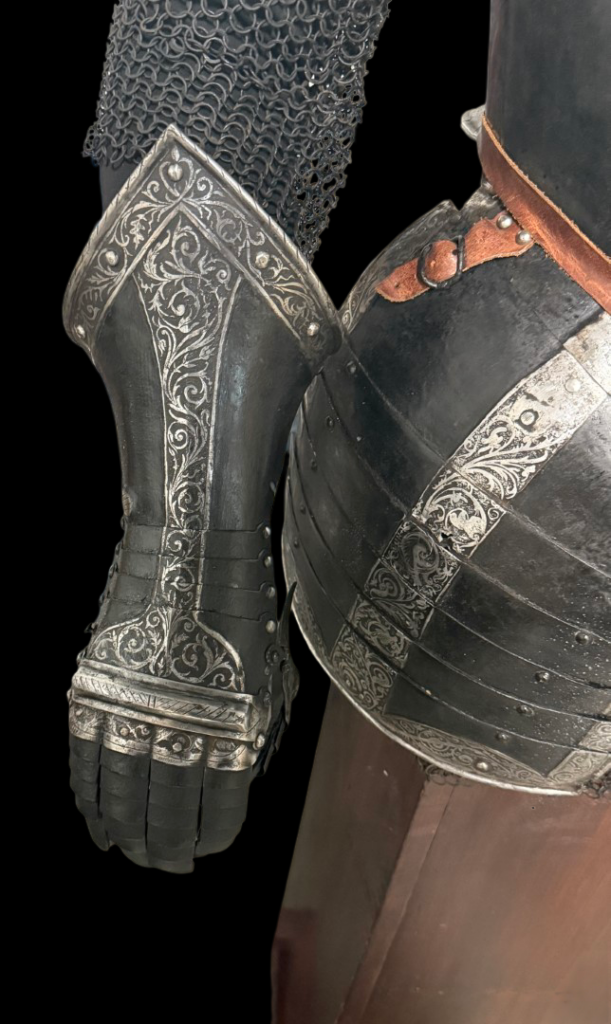
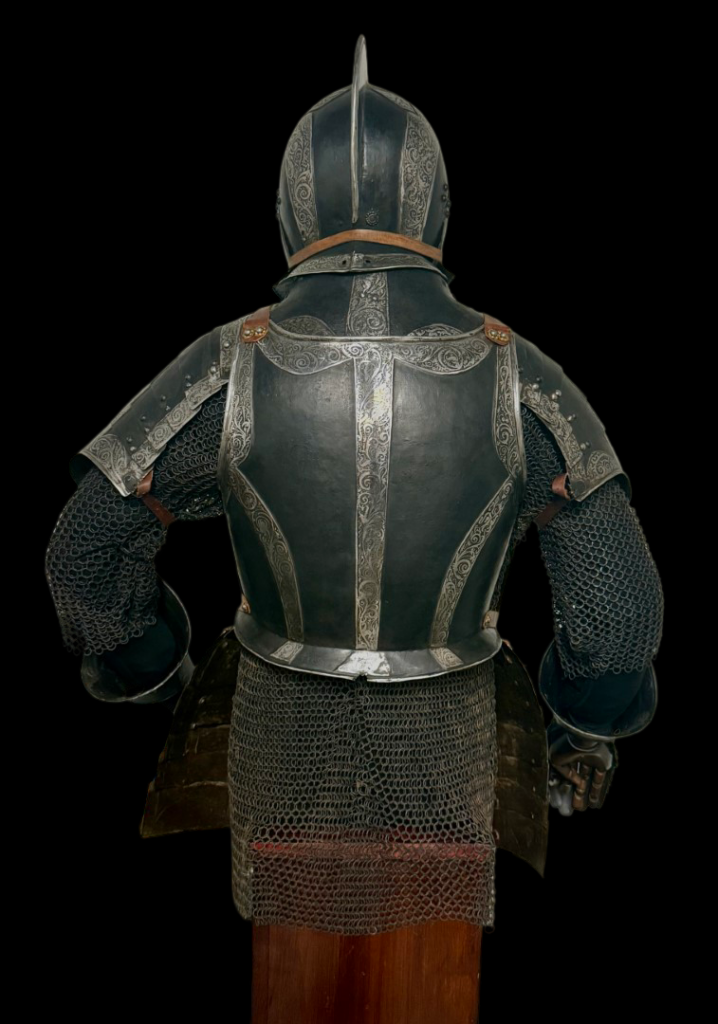
1969) HIGHLY DECORATED OFFICERS GRADE BLACK AND WHITE GERMAN ARMOR CIRCA 1580: Priced to sell today!
Introduction: When you open a door and see a Renaissance armor across the room, your eye is instantly drawn to it. It very quickly makes a load statement of chivalry…class…elegance…
Description: Constructed with a burgonet of rounded two-piece skull rising to a high medial comb, fitted at the brow with a broad obtusely pointed movable visor that pivots at the center of the skull with flat common pivots, a matching neck guard, fitted at each side with a hinged cheekpiece flanged outwards at its lower edge to serve as a continuation of the neck guard. The main edges of the helmet are formed with inward turns and gutter, and its surfaces are decorated with recessed bands with etched decoration, along with each side of the comb, against a blackened ground, a gorget formed of a single plate, both front and rear; a breastplate with an outward flanged lower edge of peascod form; and a pair of matching, symmetrical spaulders, each formed of six lames, a pair of matching besagues, long tassets of six lames, a codpiece (groin protector) decorated en suite. Backplate flanging at the bottom edge to accommodate a culet. The gauntlets have fingers attached by rivets. Mail shirt worn as an arm defense. The thumb was attached to the hand by a hinge. The metacarpal (back of the hand) was composed of lames followed by a long cuff that flared outward at the opening. Decorated en suite on the burnished areas with etching. Mounted on a plinth.
Condition: Very good, conserved /restored to museum standards.
Provenance: From the estate of an American collector.
Comparables: European museums and arsenals are full of similar armors, and some even have highly decorated ones like the example on offer.
Discussion: Full body armor (cap-a pie) evolved to half armor over a short period of time for several reasons. The decline of armor had already begun around the middle of the 16th-century. Protective defensive armor came to a screeching end circa 1640. Most attribute this to the invention of the gun, which became much more common on the battlefield toward the end of the century. However, there are other equally important reasons beyond the rise of the gun. Let’s look at the four primary reasons:
-The first reason began hundreds of years earlier when the Flemish pikemen soundly defeated the French mounted knights at Courtrai (Golden Spur) in 1302 (see page 46 in my book). This defeat altered the concept and strategy of Medieval warfare.
-The second reason (bullets versus blades) for the decline of armor was the effectiveness of projectile weapons, namely firearms, crossbows, and longbows. Years of knight training with the use of exceptionally expensive armor and close-quarter weapons could now be defeated by a man-at-arms or even a peasant with little training and an inexpensive weapon.
After 1550, the quality of gunpowder had reached such a high level that it now gave gunsmiths an advantage over the armorer. With the proliferation of firearms during this period, the response from the armor fraternity was the introduction of reinforcing breastplates. The conundrum was that the more metal added, the slower the knight moved, the less effective he fought.
-The third reason for the decline of armor actually began during the 14th-century when the Swiss challenged the alleged superiority of the cavalry versus the infantry. The Swiss achieved victory by employing their new infantry tactics during the Battle of Morgarten in 1315 (see pages 46 and 346), the Battle of Laupen in 1339, and the Battle of Sempach in 1386. The Swiss’s choice weapons during these encounters were the halberd and the pike.
-The fourth reason for the decline of armor occurred during the Renaissance (1500 With science and innovation beginning to prevail, its influence also spread to warfare and tactics. Change was on the horizon, and it would be a hard-learned lesson for the status quo.
It took about 50 years (circa 1550) for changes to be mandated to compensate for this new, better-organized, and faster style of warfare.
Conclusion: Priced to sell immediately. This armor is much more impressive in person than in pictures. The decoration and condition are superb. ACT-NOW, this one will sell fast , and you will be disappointed!!!*
All my items come with the following:
–Free shipping.
–10-day review period.
–Certificate of Authenticity.
–Autographed copy of my book.
–In the event of an international shipment, we will help assign the lowest correct Customs tariff so you pay the least.–