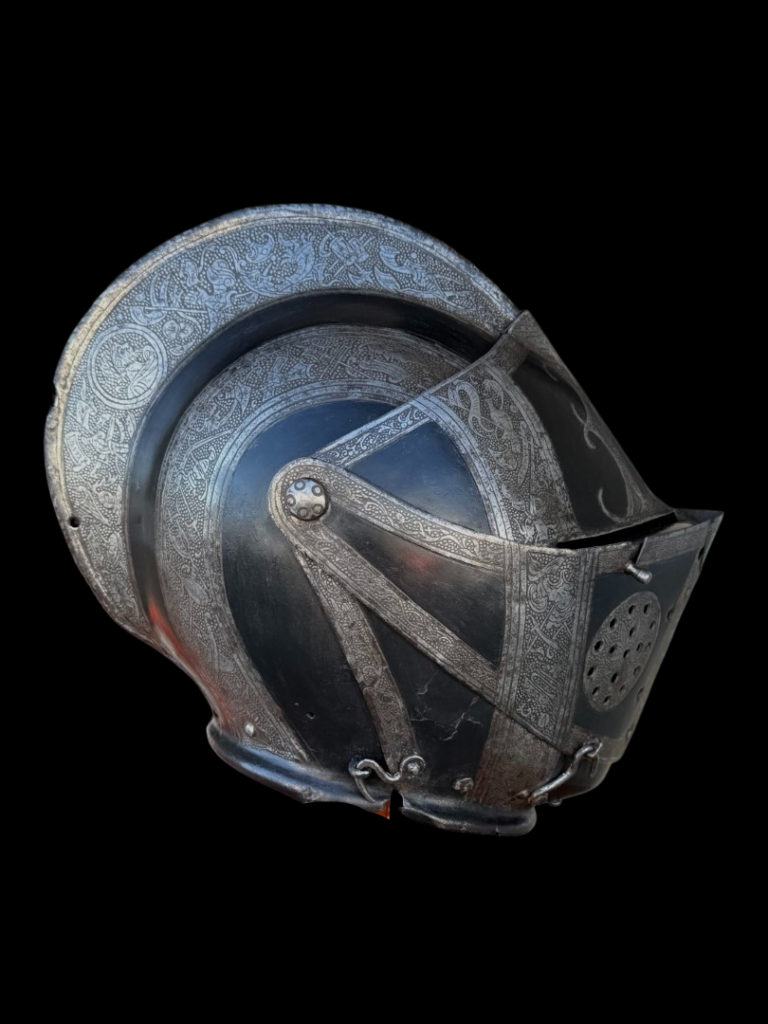
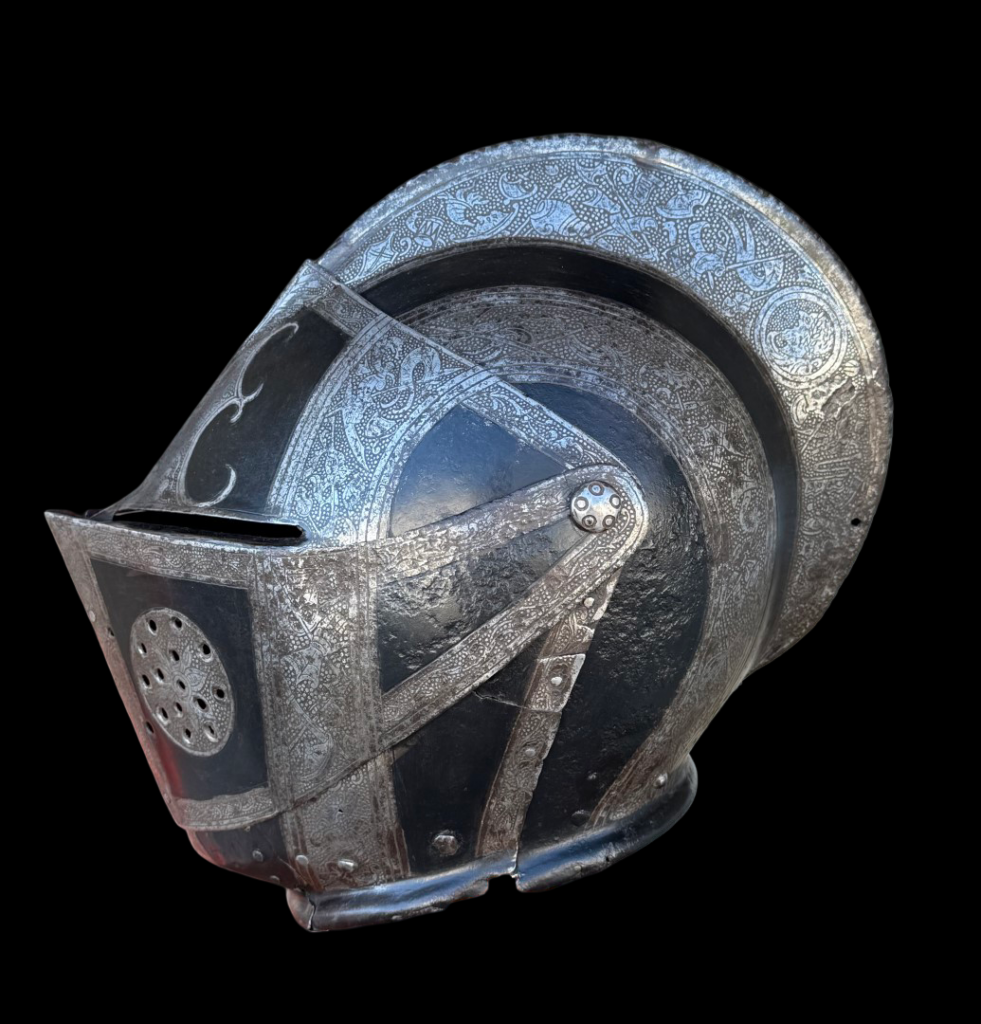
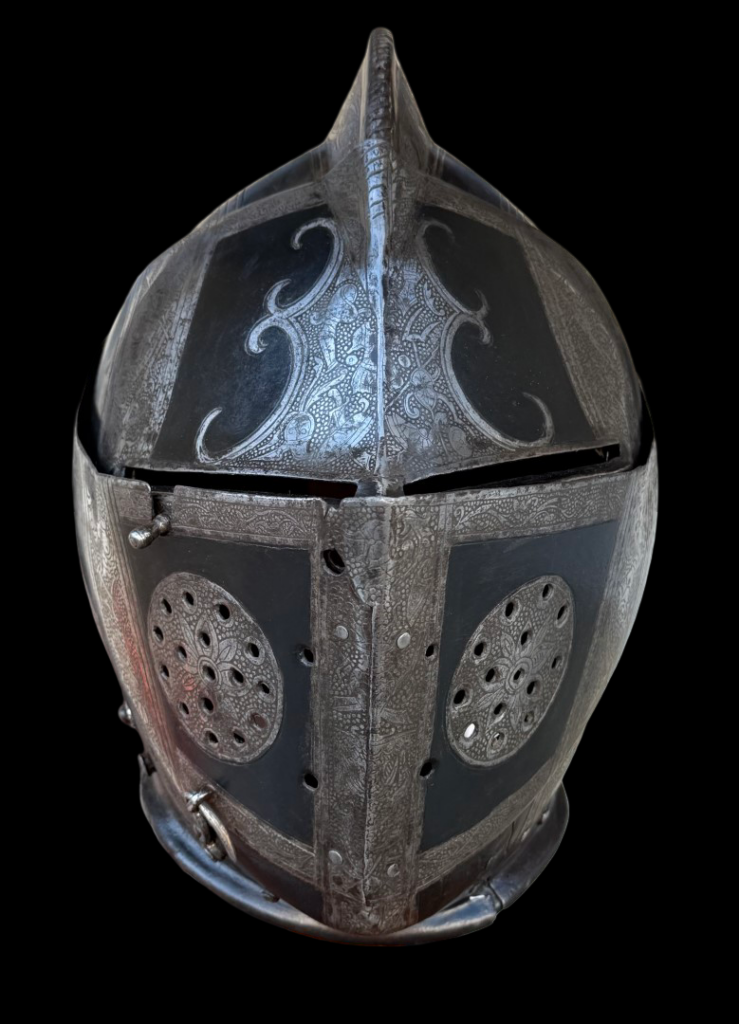
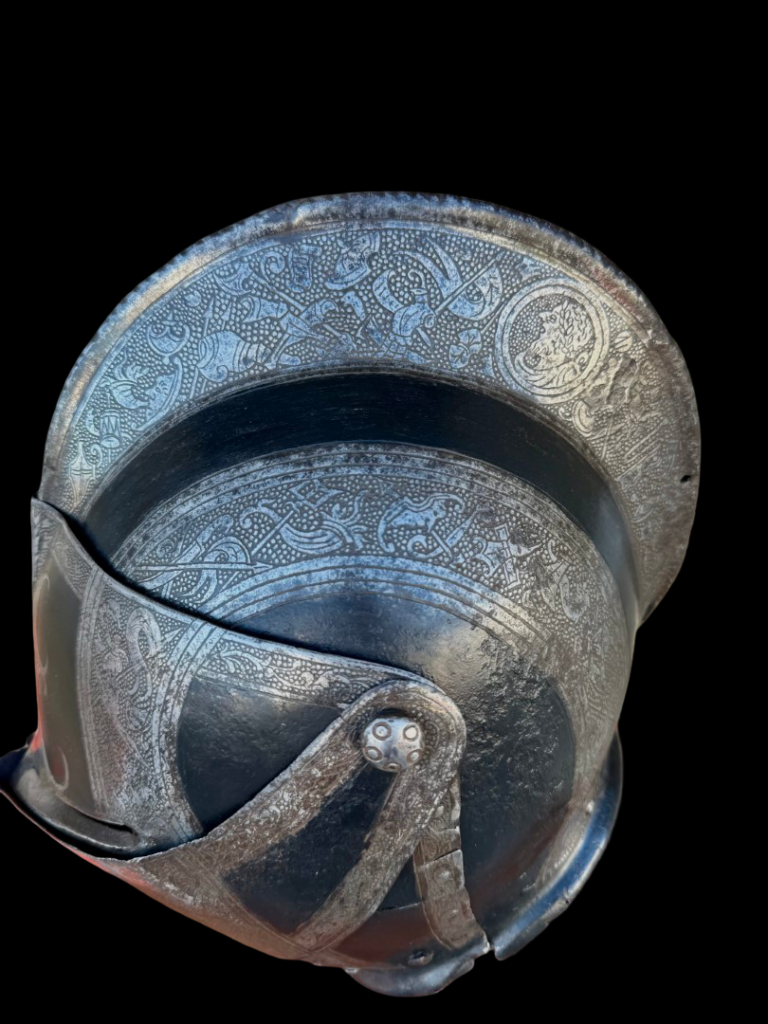
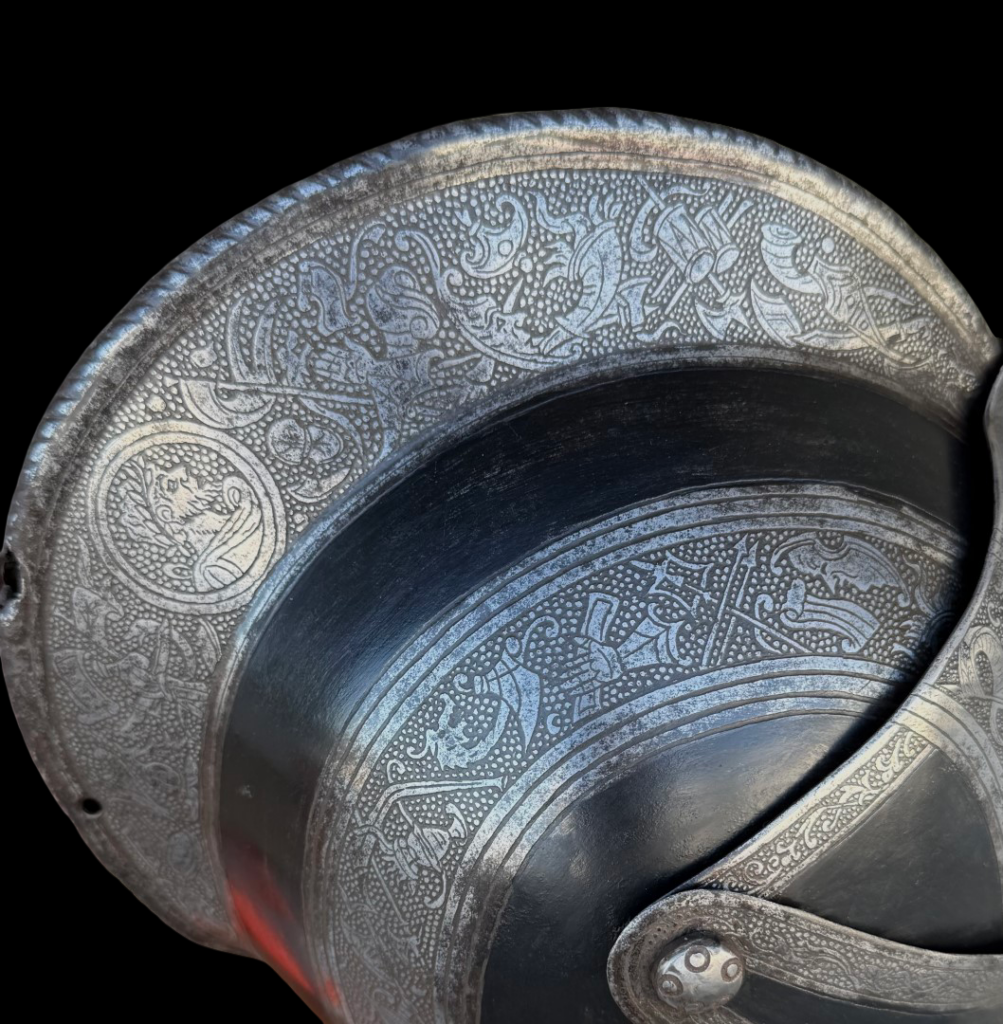
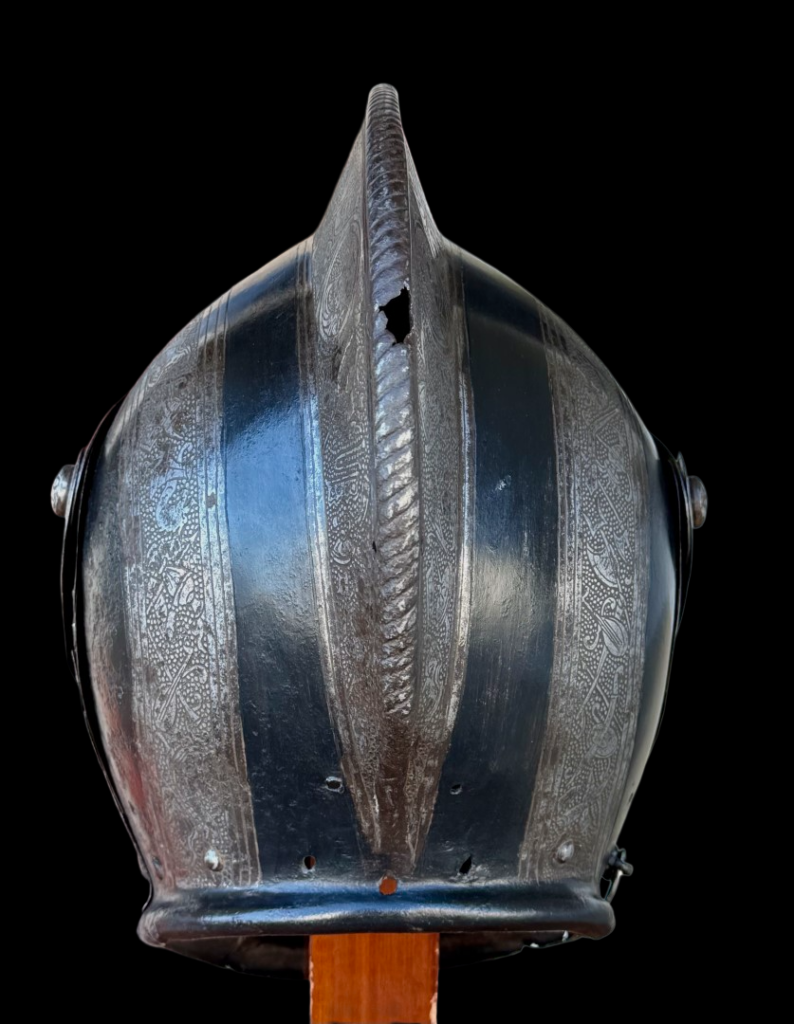
Introduction: The most sought-after Arms and Armor item by collectors and decorators is the “close helm” (closed helmet). The most sought-after close helm is etched. An etched close helm indicates that the original owner, who commissioned the helmet’s creation, was wealthy and had exceptional taste. The same can be said of a collector who owns one.
Even a person who knows very little about Arms and Armor will recognize a Medieval/Renaissance “close helm” and understand its historic value, artistic value, beauty, and mystique. The etching elevates it to a new and much higher level. When you walk into a room and look across and see a Renaissance helmet, it makes a statement of chivalry, power, class, and elegance , which reflects on its owner. Closed helmets, like fine statues, display exceptionally well on flat surfaces, such as shelves, tables, or desks.
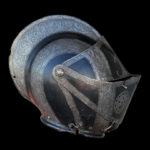
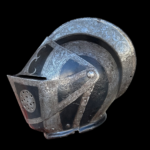
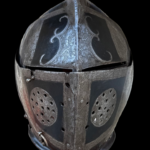
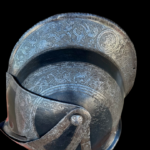
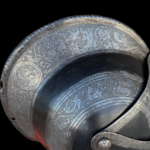
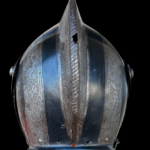
Description: Constructed with a round one-piece skull that rises to a roped medial comb. The visor, upper bevor, and lower bevor are attached by a common pivot (restored). The upper bevor is pierced with sixteen circular ventilation holes displayed evenly within a circle on both sides, a swivel hook secures from the upper and lower bevor and from the skull to the lower bevor, a steel lifting peg (restored), the visor has a centrally divided, at the bevor five holes for the attachment of a brow reinforcement, etched throughout en suite.
Condition: Good, with some wear and dings as you would expect from a 400+ year-old instrument of war, conserved/restored to museum standards.
Dimensions: Height approximately 11 3/4 inches.
Provenance: From the collection of Gottlob Herbert Bidermann, Stuttgart/Aachen, Germany. Herr Bidermann was one of Europe’s most prominent collectors of Arms and Armor. He wrote several books on Medieval and Renaissance Arms and Armor. He was appointed court expert on Medieval/Renaissance Arms and Armor by the German Government (Öffentlich bestellter und vereidigter Sachverständiger für Historische Waffen).
Discussion: The two most sought-after armor collectibles are helmets and breastplates, in that order. Both helmets and breastplates protect the two most vital parts of the knight’s body, the head and torso. Helmets (especially close helmets) are generally more expensive than breastplates.
Why are helmets and breastplates the most sought-after?
Here are three reasons:
1) Helmets are the earliest form of body armor. Both aristocratic knights and simple infantrymen used them. Helmets are the most difficult item to make in a suit of armor. Because of their elegance, workmanship, and symbolism of power and chivalry, helmets are readily accepted by most as works of art, even by non-collectors.
2) The breastplate is second only to the helmet. Even a person who knows very little about Arms and Armor will recognize a Medieval/Renaissance helmet or breastplate. If you collect greaves (see pages 122-BB and 123-BB in my book ), few people may know what they are or find them aesthetically pleasing.
3) Helmets, like a fine statue, display well on flat tops such as shelves, tables, or desks. Breastplates display easily on the wall, like a fine painting.
Conclusion: A gem like this seldom makes it to the collectors’ market. Fortunately, this helmet is not in mint museum condition, as it can now sell for a fraction of what a museum-quality Peffenhauser would fetch. In other words, it is affordable for the average collector, even though it looks like a very expensive Renaissance helmet. If it were in mint condition, it would have been preserved in a museum for all eternity, and if it were available on the market in mint condition, it would be prohibitively expensive for the average collector. ACT NOW!!! What are you waiting for?