1952 suit
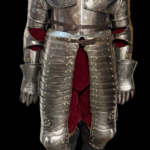
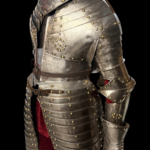
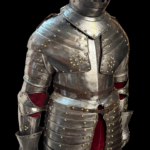
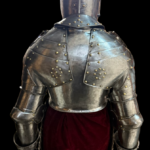
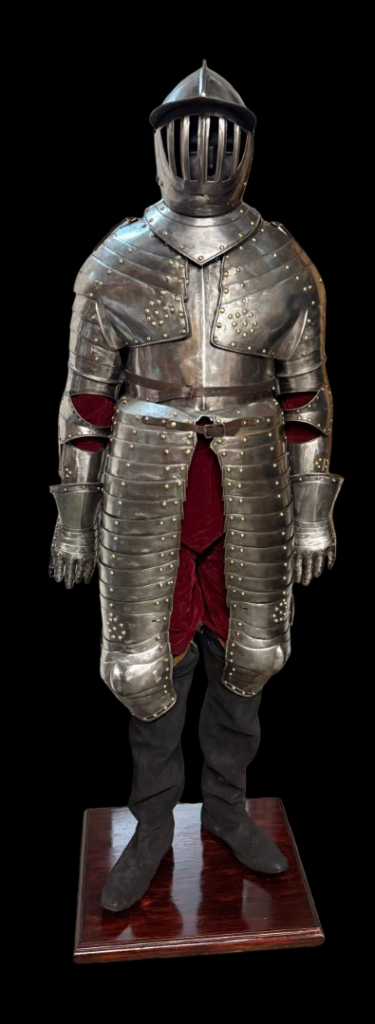
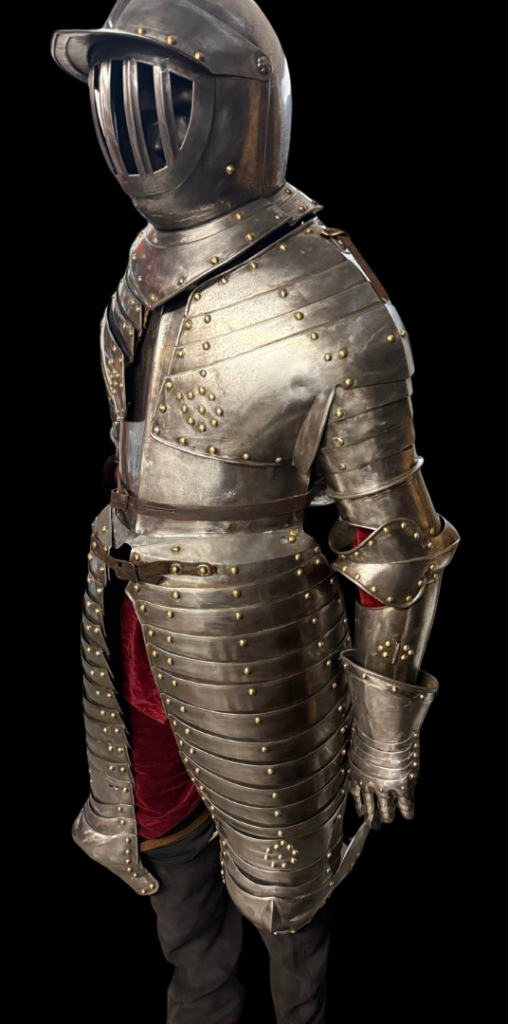
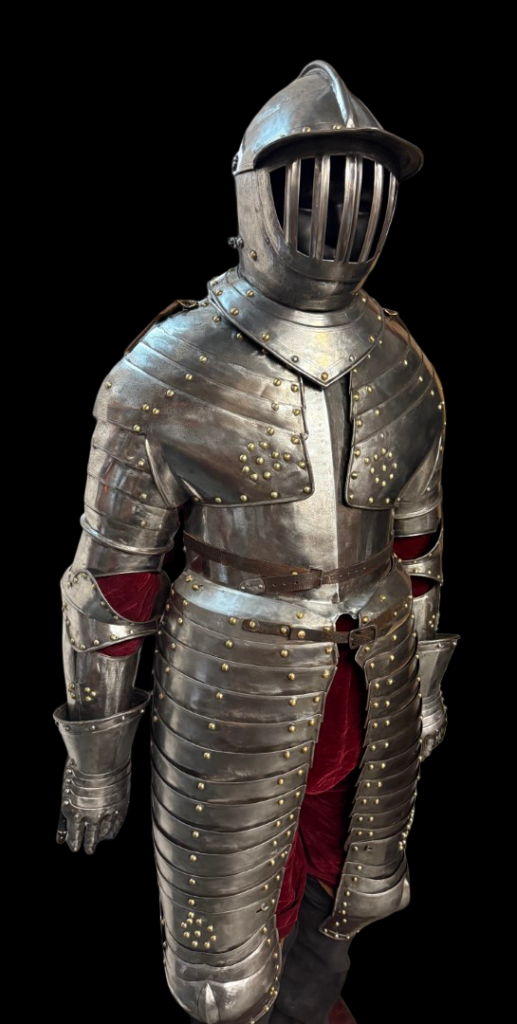
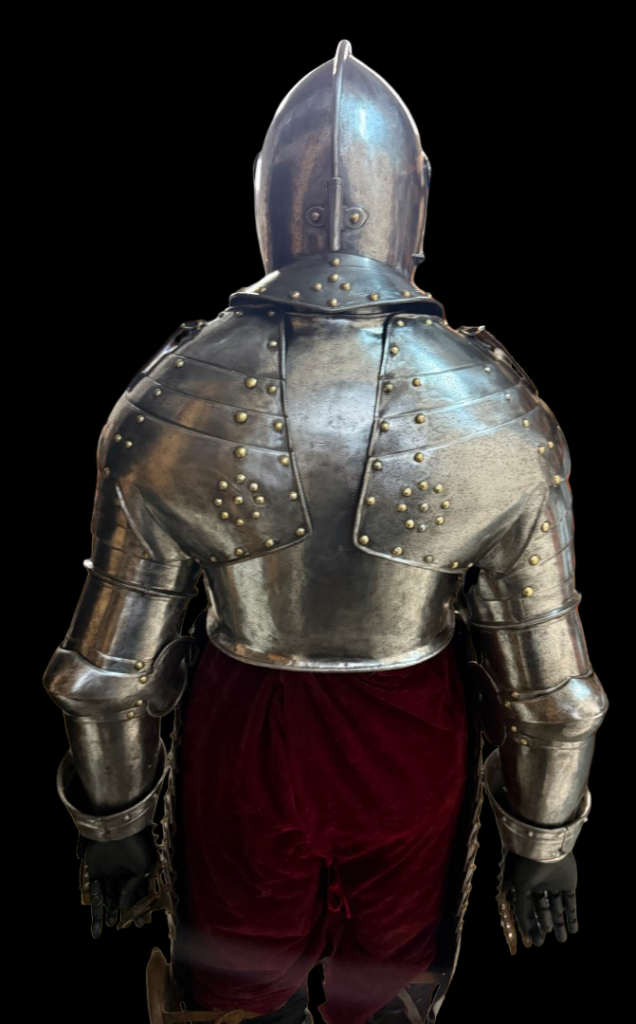
1952) AN ULTRA ELEGANT GERMAN CURASSIER HEAVY CAVALRY ARMOR CIRCA 1610: All period pieces with no Victorian replacements! Exceptionally well matched with many homogeneous pieces. Bargain-priced for a quick sale.
Introduction: Walk into the office, living room, or den of any house with a full suit of armor, and instantly your eye is drawn to it. A suit of armor makes a loud and powerful statement of class, style, taste, sophistication, wealth, power, fortitude, and a certain unique mystique that no other decoration or art can match. It speaks volumes about its owner without saying a single word.
Heavy Cavalry consisted of a three-quarter armor with a close helmet and knee-length tassets. Greaves and sabatons were replaced with leather boots. From 1620 onwards, they were referred to as cuirassier after discarding their lances. By circa 1600, the heavy lance began to go out of vogue, except for Scotland and Spain. The Germans continued to manufacture cuirassier armor much longer than England and other parts of Europe until circa 1650. The cuirassier was active as early as the English Civil War and in the Thirty Years’ War.
Mass-produced suits of armor such as this one under discussion (typically for export) were usually made in three sizes: (A) small, (B) medium, and (C) large. I believe this armor is large. Mass-produced armor is the opposite of a custom suit of armor made for a wealthy knight or nobility that was measured the same way a modern custom tailor measures for a perfectly fitting suit. Both contract production and custom-made armors are considered homogeneous if all parts are kept together.
Discussion: The decline of armor had already begun around the middle of the 16th century. Protective defensive armor came to a screeching end circa 1640. Most attribute the decline of armor to the effectiveness of projectile weapons, namely firearms, crossbows, and longbows (there are, however, three other reasons equally important, see page 180 in my book), which negated the Knights’ advantage of years of training with the finest of weapons.
Years of knight training with exceptionally expensive armor and close-quarter weapons could now be defeated by a man-at-arms or even a peasant with little training and an inexpensive projectile weapon. Projectile weapons were now the Knights’ most feared weapon. The crossbow sent shock waves through the knightly community; it was a game-changer. To solve this problem, the knightly class turned to the highest authority of its day, the Pope (see page 400 in my book).
Pope Innocent II, by decree at the Second Lateran Council on April 1139 (Canon 29), banned the crossbow and bows. The penalty for violating the Pope’s decree was immediate excommunication from the church and damnation to hell. The ban only applied to Catholics/Christians. Papal Canon #29 states: “We prohibit under anathema that murderous art of crossbowmen and archers which is hateful to GOD, to be employed against Christians and Catholics from now on.”
After 1550, the quality of gunpowder had reached such a high level that it now gave gunsmiths an advantage over the armorer. The armoire’s response was the cuirassier armor.
Description: Constructed of white metal with a two-piece round skull formed in two pieces and joined at a tall medial ridge. The peak, visor, and bevor are attached to the side center of the skull by dual pivots; the visor with five embossed fluted bars. The two gorget plates (raised overlap), the lowest in both the front and back, each descends to an obtuse central point, one-piece pescod form breastplate with an inwardly turned neck and strong medial ridge. The bottom of the breastplate curves upward to accommodate a fourteen lame tasset attachment with knee cop by mushroom-shaped studs, pauldron, and vambrace connected by a turner, lower cannon, and elbow cop complete the arm defense. Long tassets with garniture pointed cuffs (that can be removed by a garniture turning pin on the 12th lame) form part of the same series. The fingered gauntlets are constructed with long, flared, and pointed cuffs, four metacarpal plates, a wrist plate, a knuckle plate, and scaled fingers. The armor decoration at the edges with beveling and roping at the edges in en-suite, mounted on an antique wooden plinth with leather boots.
Provenance: From a collector with over 60 years of experience who feels it’s time to thin his herd.
Provenance: Very good.
Conclusion: This armor is even more impressive in person than in pictures. Many of the pieces of this armor, in my opinion, are homogeneous and match perfectly. Bargain-priced for a quick sale. Don’t wait and act now. !!!*.
All my items come with the following:
–Free shipping.
–10-day review period.
–Certificate of Authenticity.
–Autographed copy of my book.
–In the event of an international shipment, we will help assign the lowest correct Customs tariff, so you pay the least.
I believe you will be very pleased. ACT-NOW!!!*