1946 Dagger
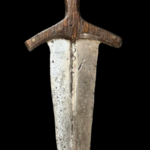
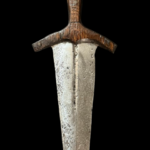
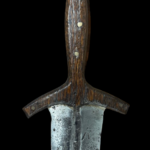
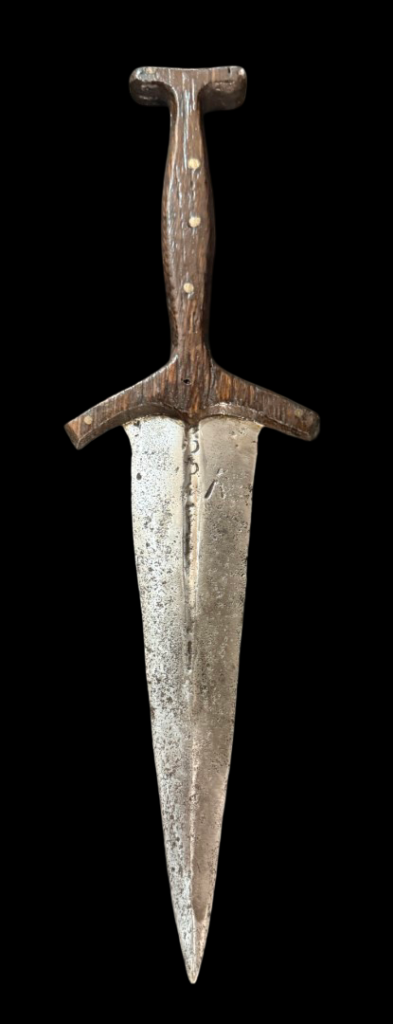
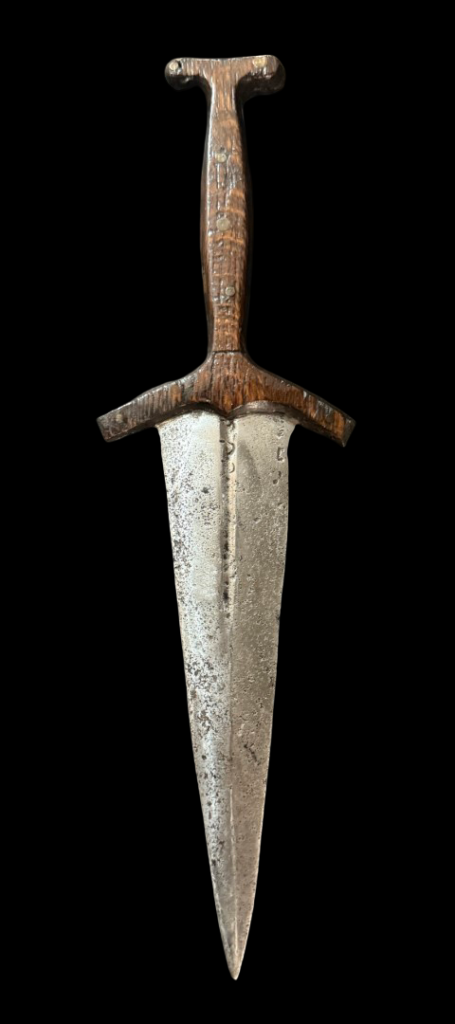
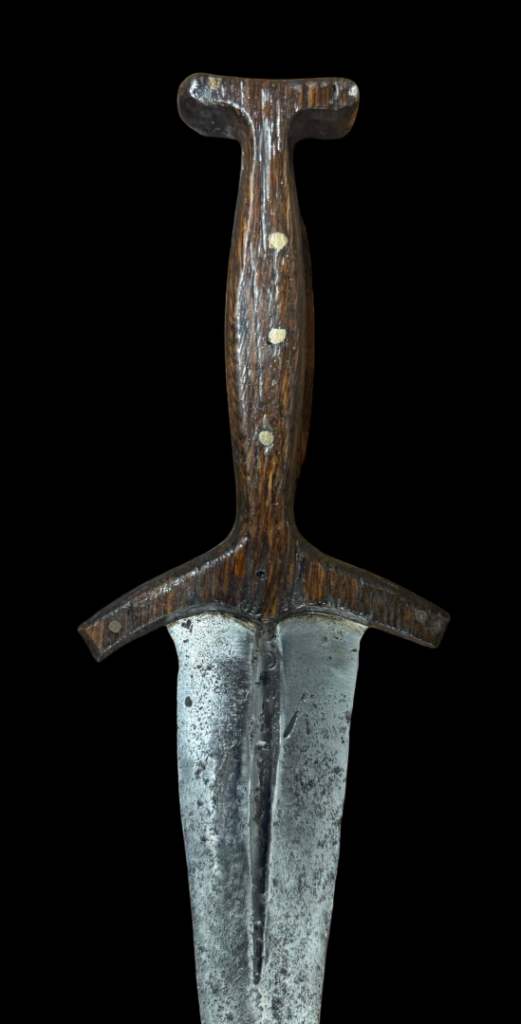
1946) SUPERB DECORATED STOUT SWISS BASILARD DAGGER WITH WOODEN GRIP CIRCA 1400:
Provenance: By tradition, found in lower Bavaria.
Discussion: Basilard is a French or Latin term identifying a dagger with a hilt shaped like a capital I (or, in our example, a capital T) developed during the 1300s. Basilards appear in contemporary literature, poetry, paintings, effigies, brasses, and other period representations. After circa 1350, the basilard became a favorite of civilians and peasants in England.
The basilard was probably the most used dagger circa 1350 in Western and Central Europe. The basilard was believed to have originated in South Germany or North Italy in the late 1200s; this appears in many older publications. However, a discovery at the Datini archives in Prato, Italy, dated 1375 by Claude Blair of the Victoria and Albert Museum, indicates the dagger’s origin is Basel, Switzerland, hence the name Basilard.
The basilard was part of mainstream Medieval Europe. A few basilards have survived that were made for the megawealthy. Basilard sheaths are rare. Their sheaths consisted of a metal throat, chape, and middle band. Because leather is organic, few leather sheaths have survived.
The sheath was worn in various ways:
1) On the right side, hanging from the belt, sword belt, or sword hanger.
2) Hanging in the front from the sword belt.
3) Seldom carried on the lower back. The basilard finally evolved into the Swiss (Holbein) dagger in the late 1490s. Some refer to the original variant as the Swiss basilard (see page 320 in my book).
All my items come with the following:
–Free shipping.
–10-day review period.
–Certificate of Authenticity.
– Free autographed copy of my book if you do not have one.
– In the event of an international shipment, we will help assign the lowest correct Customs tariffs, so you pay the least as little as 5% or even nothing.
I believe you will be very pleased. ACT-NOW!!!*