1863 Shield
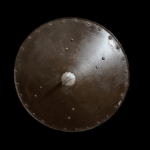
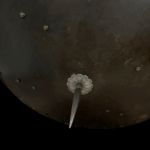
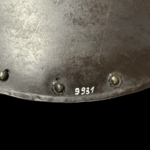
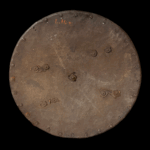
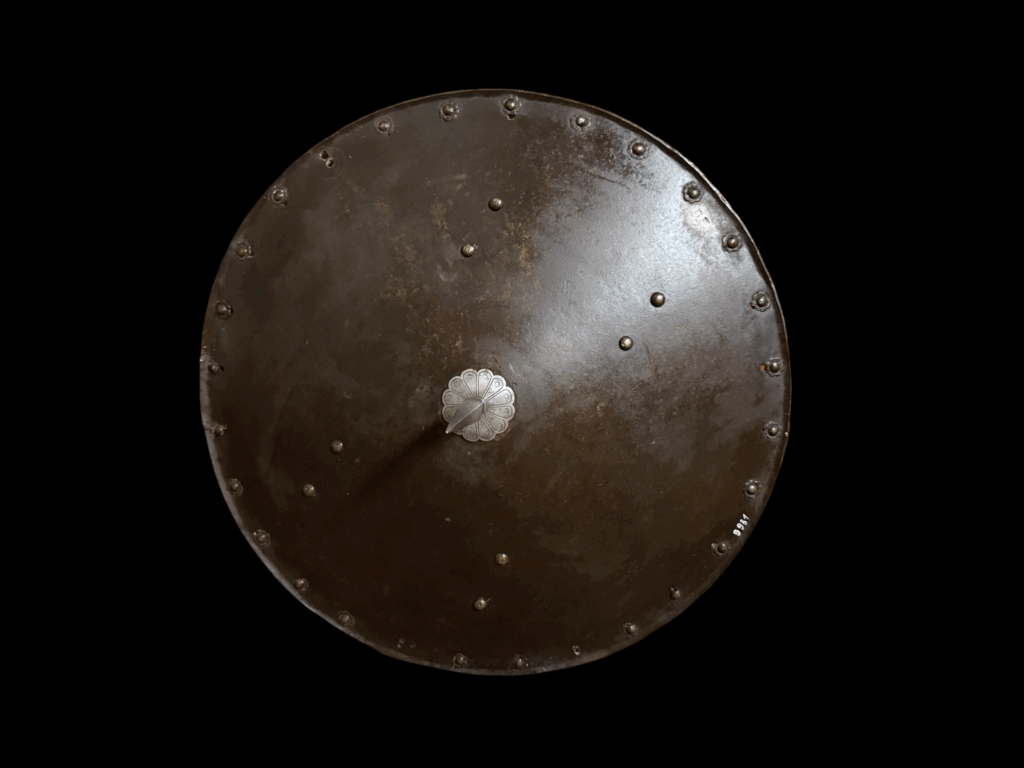
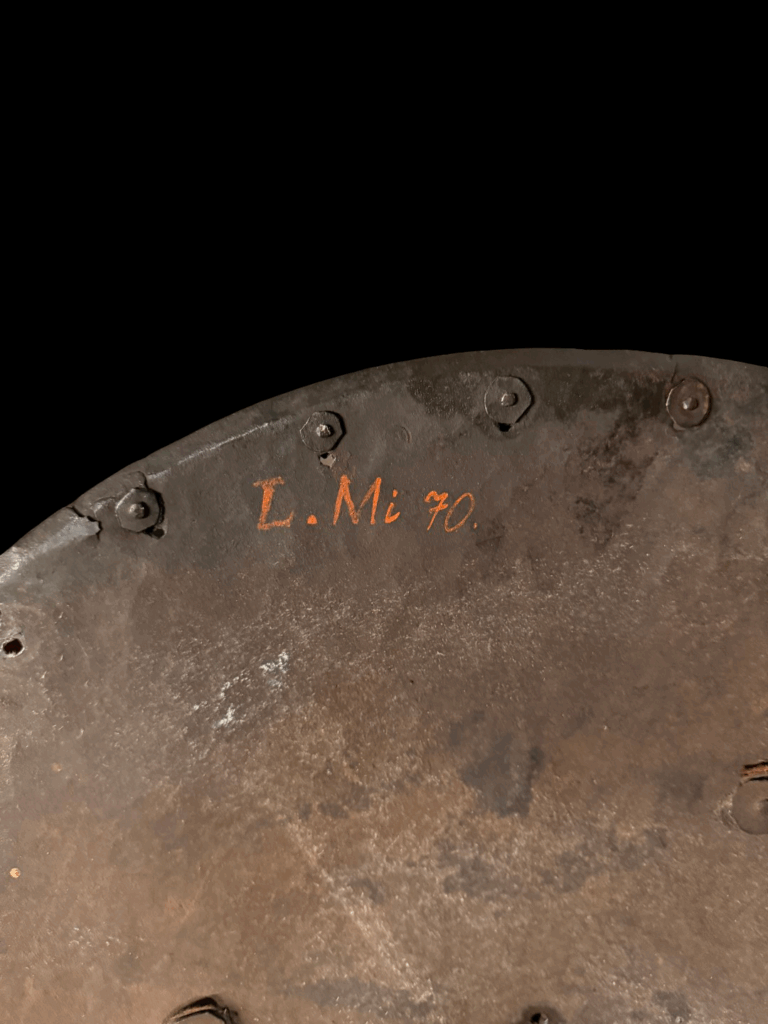
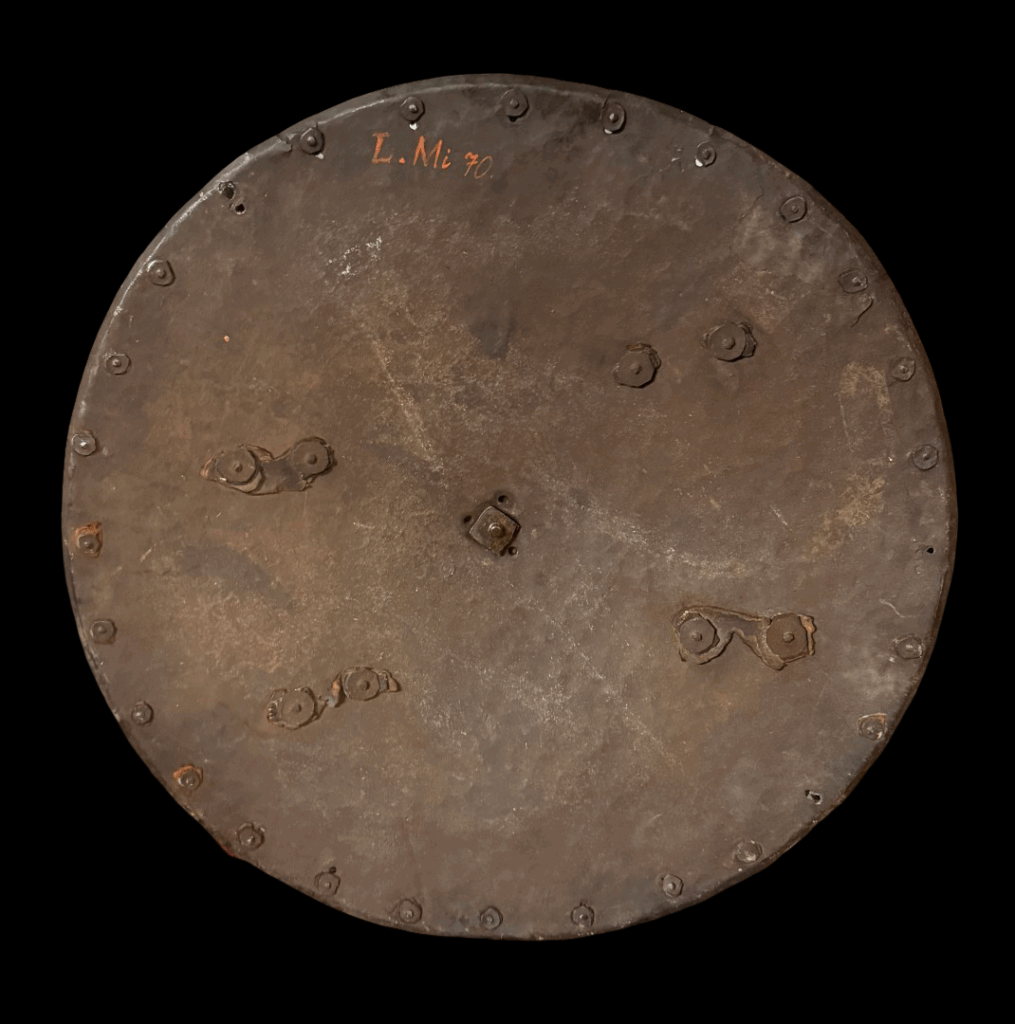
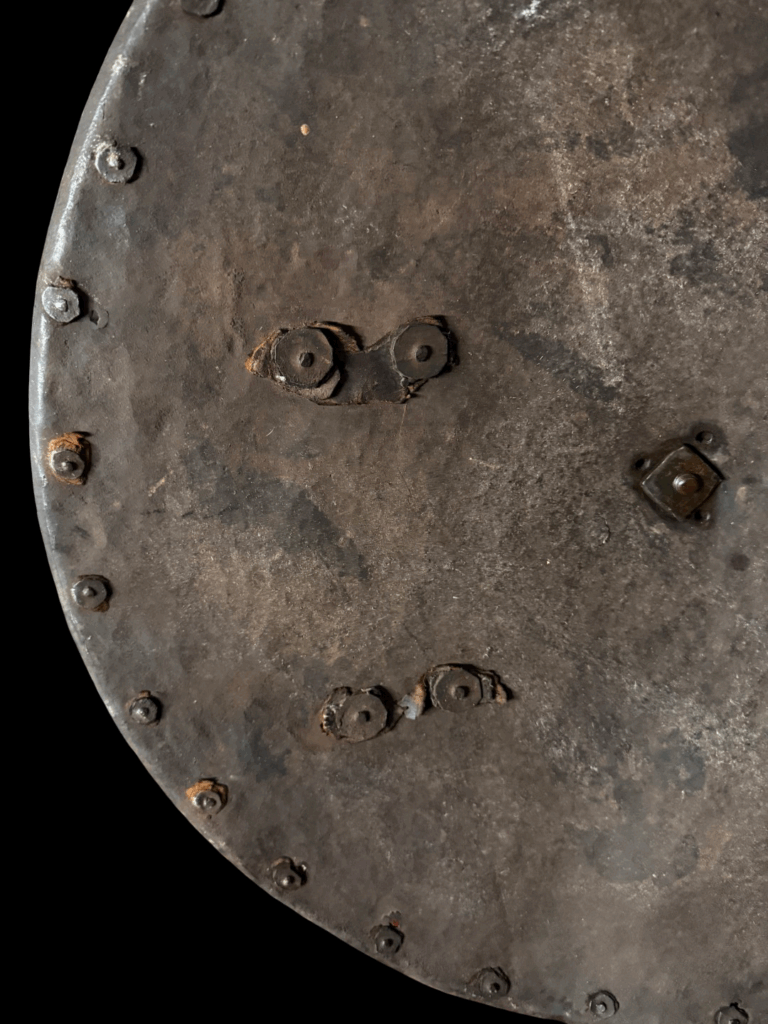
1863) A MINT STEEL NUREMBERG SHIELD CIRCA 1590 FROM THE TOWER OF LONDON/ROYAL COLLECTION: With two makers’ marks, two museum control numbers, original spike and engraved boss, and original black from the hammer finish! I have never seen a shield from this period in this condition or impeccable provenance; it’s a time capsule collectors’ dream.
Introduction: This is an excerpt from page 28 in my book, which explains it best.
FACT TO KNOW: A Selling Scandal At Two Of The Most Prestigious Museums In The World!!!
This dirty little secret has remained deeply buried for many years. This tidbit of knowledge is offered to preserve provenance and not to air dirty laundry. It involves two very prestigious museums. The first is the Museum of Artillery, housed in the Rotunda, Woolwich Common, in Southeast London. If you bought Arms and Armor from Peter Dale Ltd. in London (no longer in business) in the late 80s or early 90s, you might have acquired pieces from the Tower of London (Royal Collection), and the provenance should be preserved for posterity.
Almost all museums sell items they no longer want at auction, usually to raise funds for the museum. Deaccessions need to be arm’s-length transactions. As a result, an international auction house is almost always used to prevent favoritism or behind-the-scenes skullduggery.
Although the Rotunda Museum formerly contained a variety of military equipment taken as souvenirs or trophies from all over the world by British artillery officers, the trophies of Arms and Armor that decorated its walls were largely derived from the national arsenal at the Tower of London (Royal Collection). In the 19th-century, the Board of Ordnance, who was responsible for the maintenance of ancient arms forming part of the Tower of London’s collections, willingly lent for decorative purposes not only to other castles in Britain, such as Windsor and Edinburgh, but also to regimental messes, government offices, and even sites abroad, including ones in Argentina, Rhodesia, and the United States. Roughly 32,000 pieces were involved.
The Rotunda Museum was one of the Board’s largest borrowers. In 1927, however, as a result of the recommendation of the Cottesloe Committee concerning the rationalization of the country’s arms collections, much armor was sent from the Rotunda to the Tower in exchange for artillery. Nevertheless, some armor remained at the Rotunda Woolwich (Royal Artillery Museum, until relatively recent times, mainly for display rather than didactic purposes.
However, in the 1980s, the Board of Trustees at Woolwich decided to dispose of its armor. Normally, this would have been done openly by auction. However, the Board was aware that the Tower would have legitimate claims on the greater part of its remaining inventory, so they chose to sell it secretly through the London dealer Peter Dale Ltd. In the collections of the Rotunda, there were many good pieces, including elements of an important 17th-century royal armor belonging to a helmet still in the Tower Armories. It was depicted in a portrait of the 17th-century artist, Michael Wright. Two further groups of elements belonging to the same armor had already been sold by the Rotunda Museum to Peter Dales. Peter Dale’s observant manager was upset at the armor being split up. He, therefore, exposed the selling scheme to the Tower of London and offered to sell the pieces back to the Tower at a nominal price. Other items were saved in this fashion.
This incident means hundreds of pieces sold by Peter Dale in the late 80s have an exceptional provenance; you might have one in your collection and not be aware of it. If you think you do, send me pictures. I have already found a few.
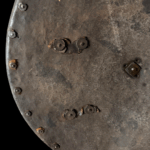
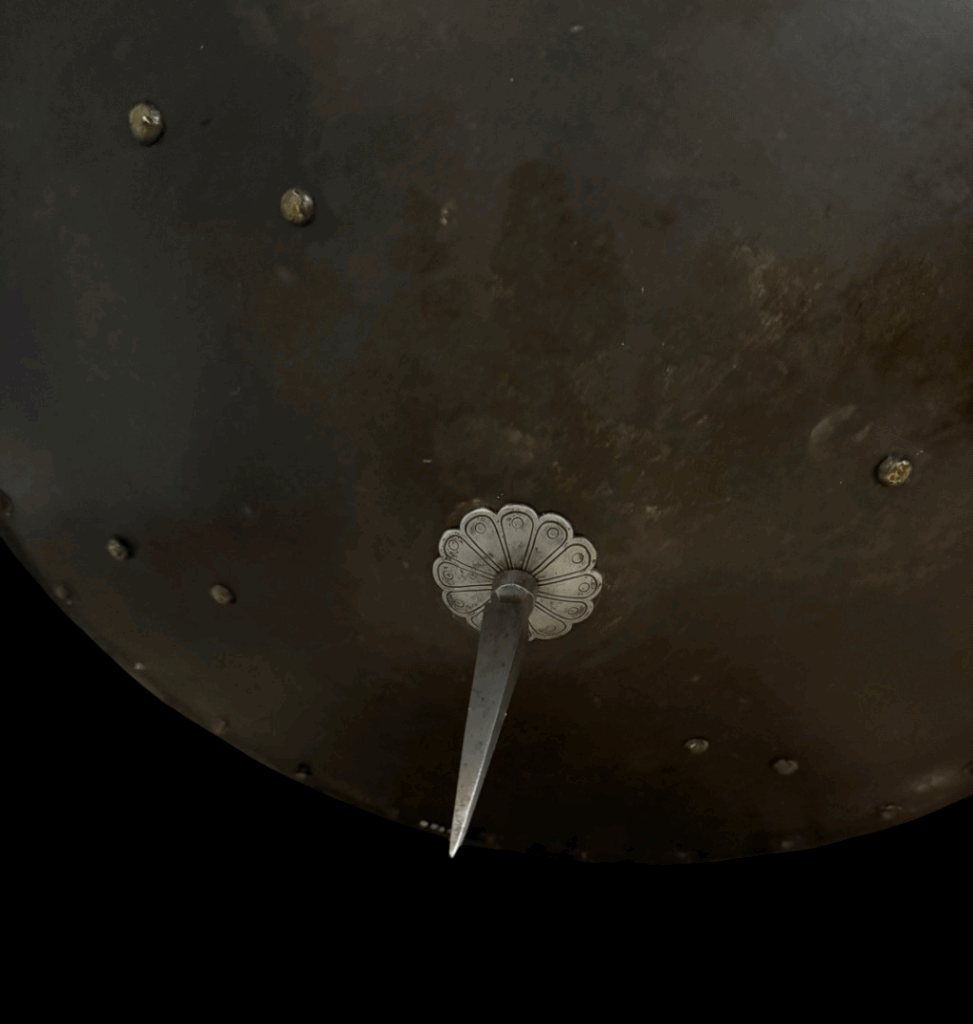
Description: Constructed with a convex circular form rising at its center to a spike and etched decorated boss, around its edge a series of brass rosette washers (three missing), two holes possibly later for suspension purposes, retaining fragments of its original leather lining, and fitted at each side with two pairs of rivets and washers (for the attachment of an enarmes) their brass heads doom shaped, a delamination on the inside edge the whole possessing a black-from-the-hammer finish.
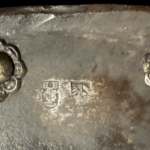
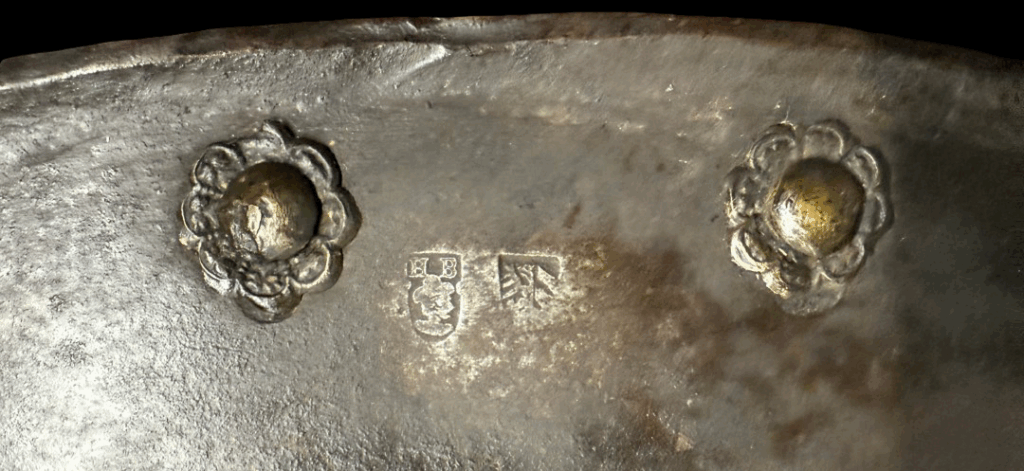
Marks: The outside edge is struck externally with the “beschau” (quality-control mark) of the City of Nuremberg. A second mark with the initials HB, and underneath it the figure of a contemporary person, almost certainly the armorer himself.
Dimension: Approximately 24.5 inches in width.
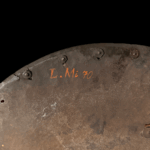
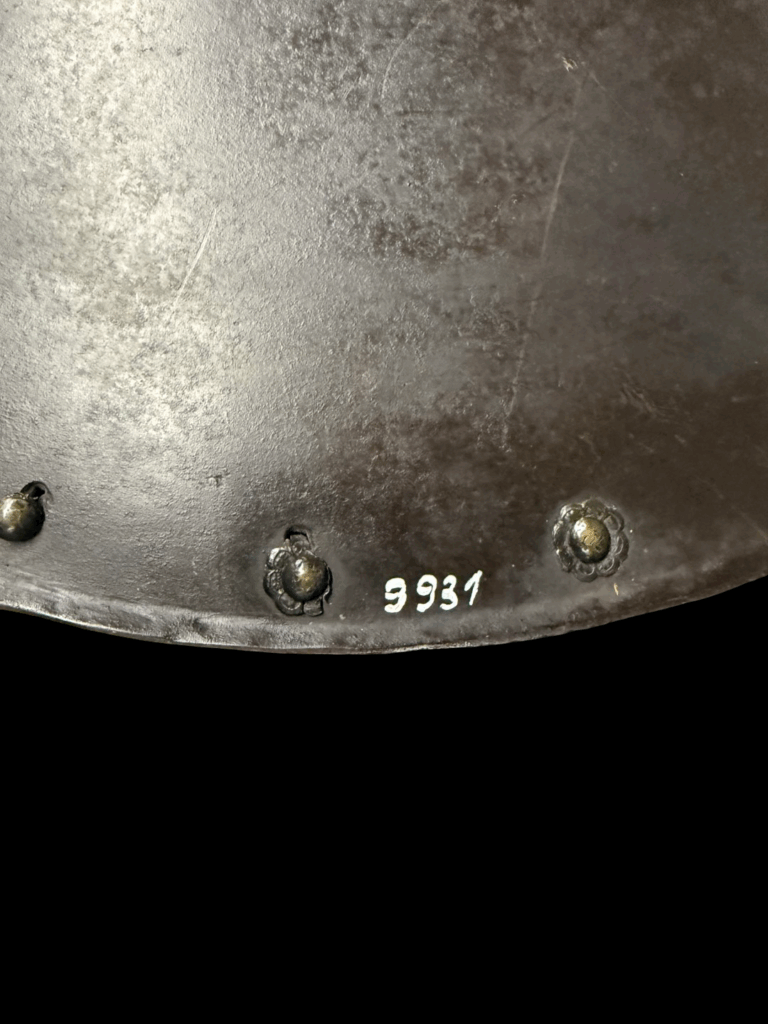
Inventory control numbers: 9931 in white and L.Mi 70 in red.
Discussion: The story of the shield in Europe begins with our old friend, the Bayeux Tapestry (see page 51 in my book). The Normans and Saxons used different shields.
• The Saxon shield was circular or oval and concave (see page 403-A).
• The Normans carried kite-shaped, concave shields (see page 403-B).
Until the 1500s, shields shared the same construction method, mainly wood covered in gesso canvas with strips of metal or horn as reinforcement. The shield was borrowed from the tradition of the Roman legions. The Romans used to paint the symbol of the legions to which they belonged on the shields used by their troops so that they could easily be distinguished from the opponents’ army, even from a distance. Not only did the Medieval/Renaissance shield offer protection during combat, but it also served as a differentiation between enemies and friends during ongoing battles.
After 1450, shields began to lose popularity. By now, full-body plate armor was in wide use, making the shield much less important than in the past. However, with the popularity of half and three-quarter armor circa 1550, shields once again came into vogue. Shields were used by the infantry and private, and civic guards (see page 161 in my book).
Provenance:
-An English collection.
-Peter Dale, London.
-Rotunda, Woolwich Common, in Southeast London.
-Tower of London (Royal Collection).
Conclusion: I have never seen a shield from this period in this mint museum condition; it’s a time capsule.
This highly collectible piece of Renaissance warfare has everything a true collector could want.
– Until today, I had never seen a maker’s mark on a shield, not to mention two like this one has!
– Impeccable, highly sought-after provenance. Prove
– Not one but two museum control numbers. One from the Rotunda, Woolwich , and another from the Tower of London (Royal Collection).
– Original black from the hammer finish!
– Leather remnants of the enarmes.
ACT-NOW, this one should sell quickly , and to get another would be like finding the proverbial needle in the haystack. Opportunities like this in the collectors market seldom repeat themselves!!!*
All my items come with the following:
–Free shipping.
–10-day review period.
–Certificate of Authenticity.
–Autographed copy of my book.
–In the event of an international shipment, we will help assign the lowest correct Customs tariff so you pay the least.–