1821 Daggers

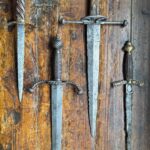
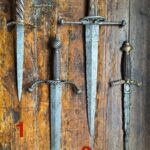
1821) FOUR SUPERB DAGGERS CIRCA 1550-1600: Priced to sell much lower than auction house prices. For a connoisseur collector who demands the best at bargain basement prices!!!

All my items come with the following:

–Free shipping.

–10-day review period.

–Certificate of Authenticity.

–Free autographed copy of my book if you do not have one.

I believe you will be very….very…. pleased. ACT NOW!!!

Introduction: The 1600s accelerated the decline and importance of the dagger and increased the sword’s popularity. In certain parts of Europe, notably the north, daggers were still used for dress during festive occasions. The exception was the left-hand dagger and the stiletto.  Left-hand daggers (a modern term) were essential to the fencing strategy. Left-hand daggers are used in conjunction with the rapier to maximize a combatant’s swordsmanship. The left-hand dagger was used to parry, block, trap, and redirect the opponent‚ sword to create an opening for the rapier to administer the “coup de grace.” However, a good swordsman could also reverse the roles and use the rapier to set up the left-hand dagger for the finishing stroke.

The left-hand dagger lost its appeal after approximately 1675, except in Spain, the Spanish Netherlands, and sections of Italy under Spanish control, which still maintained a very strong tradition of fencing. The left-hand dagger construction reached its zenith circa 1675.

THE DAGGERS UNDER DISCUSSION (1-4) 

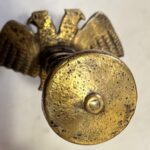
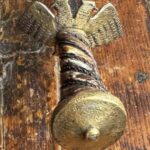
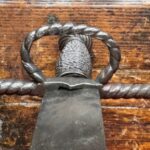
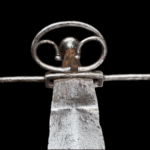
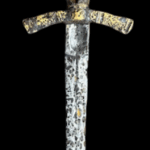
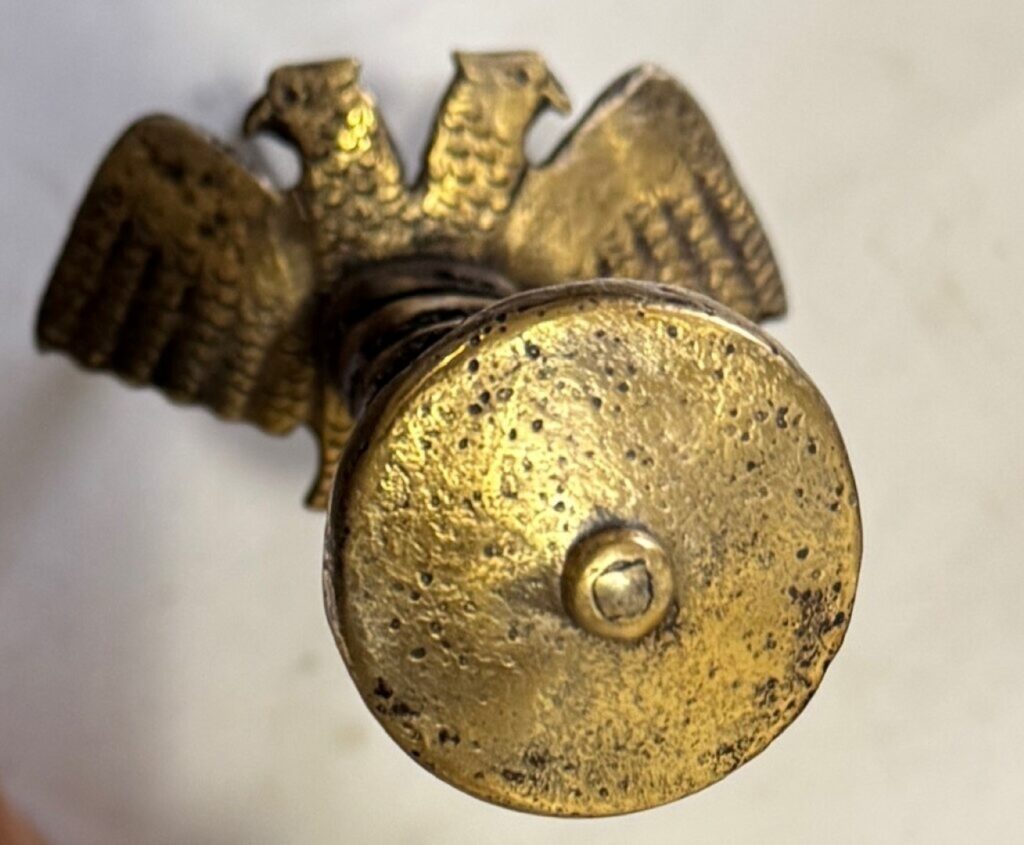
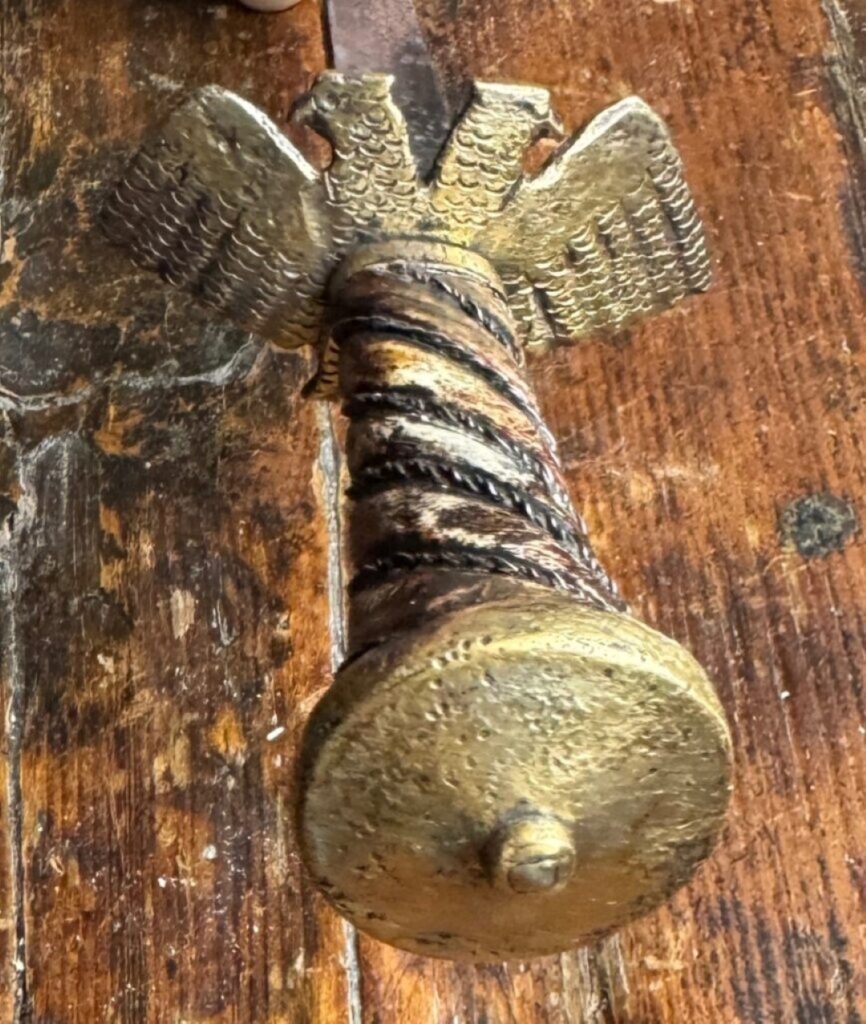
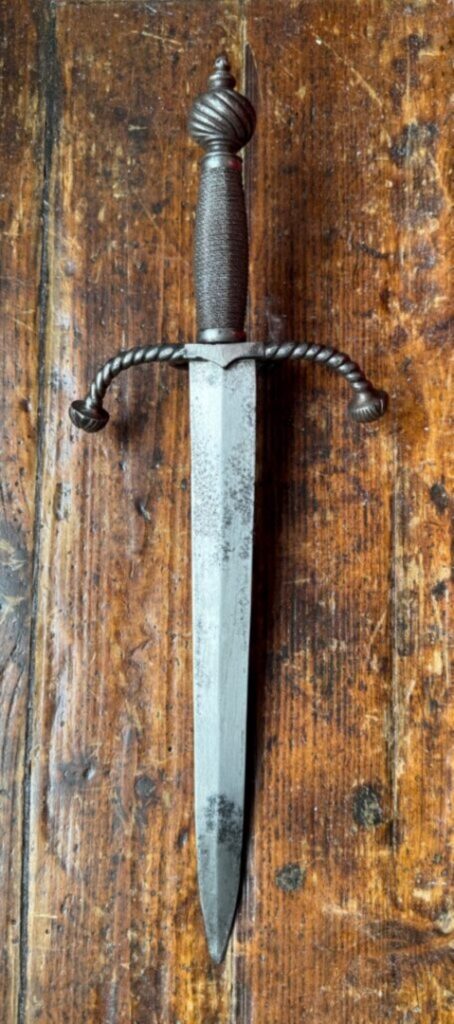
1) BEAUTIFUL GILDED AND  CHISELED DAGGER WITH A SUPERB DOUBLE EAGLE GUARD CIRCA 1550-1600: Very unique, rare, and elegant. A lot of value for the money.

Description: Constructed with a conical grip and cap pommel with a finial button with a double eagle guard
and a thick razor-sharp one-edged blade. The hilt is decorated with gilding, which is in exceptional condition.
Discussion: The primary combative use of the dagger was stabbing.During the Medieval and Renaissance periods, knife fighting focused on penetrating mail and other soft armor, such as non-hardened leather or quilted (padded) fabric. Therefore, the primary strike was with a downward grip on the dagger. In modern knife fighting, the opposite is true; now, the upward grip with the blade facing up is most often used. Since people no longer wear armor, an upward knife thrust or slash will easily penetrate contemporary clothing.
 Daggers in Europe did not evolve until circa 1250. From circa 1320 to circa 1520, the dagger was part of the repertoire of the fully armored knight. The dagger now played a new role as a support weapon for the rapier, starting circa 1580. The 1500s were the apex of dagger design and use. Around 1530, the sword began to be worn as part of the attire of knights, nobles, and other affluent individuals. Daggers, if worn, were an augment to the sword. The decoration on the daggers of those of wealth and status became increasingly important. Decorations included etching, silver, gold gilding, inlay, and chiseling on hilts. Simple, inexpensive daggers remained popular with peasants and those of lower means.
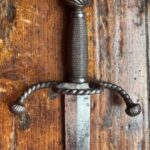
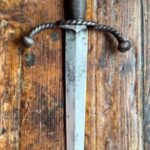
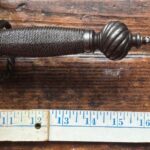
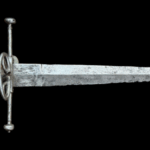
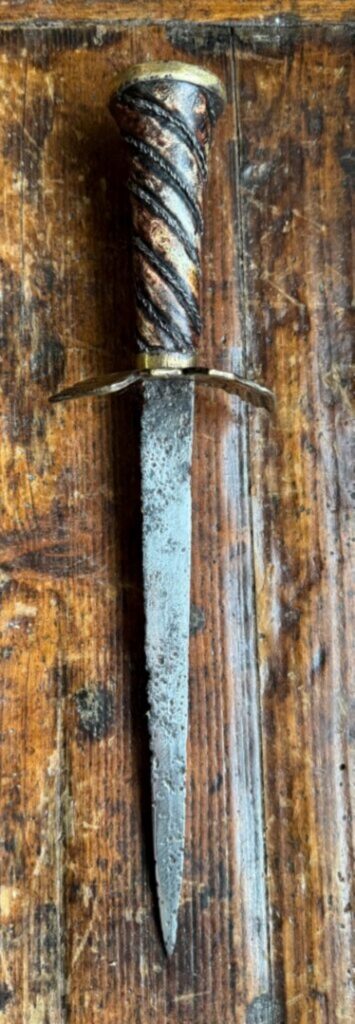
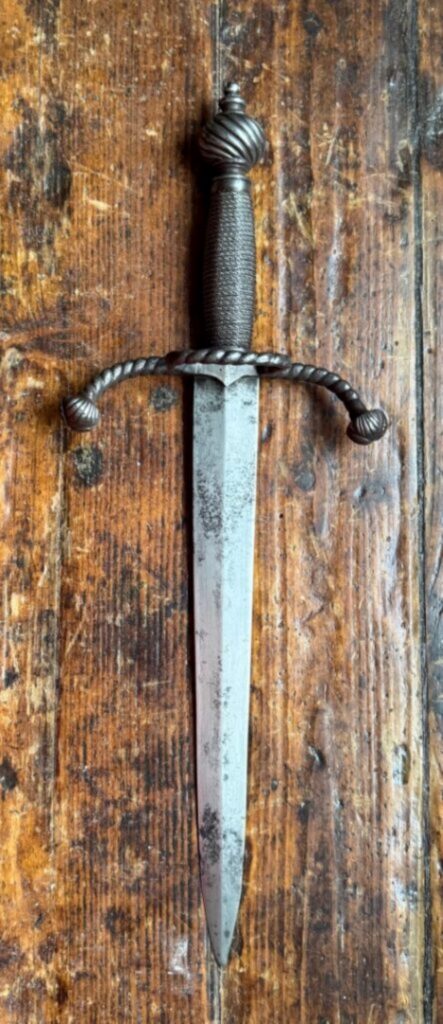
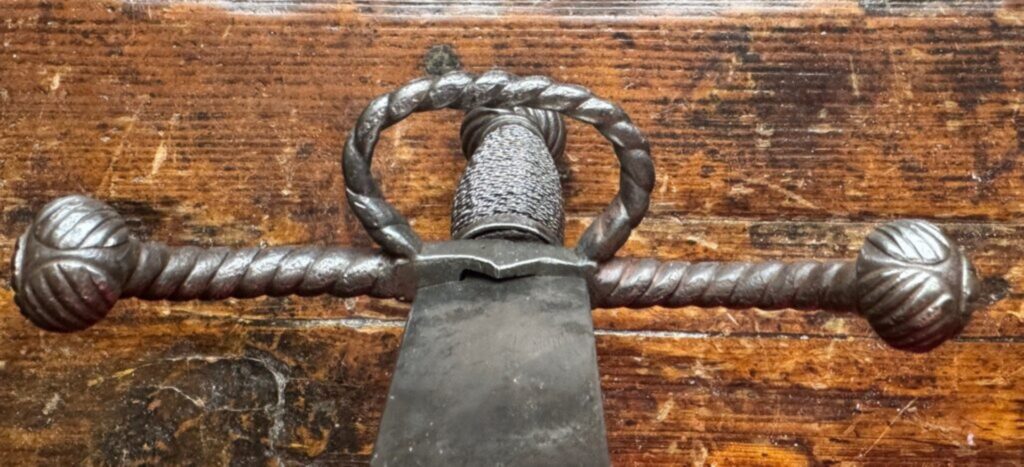
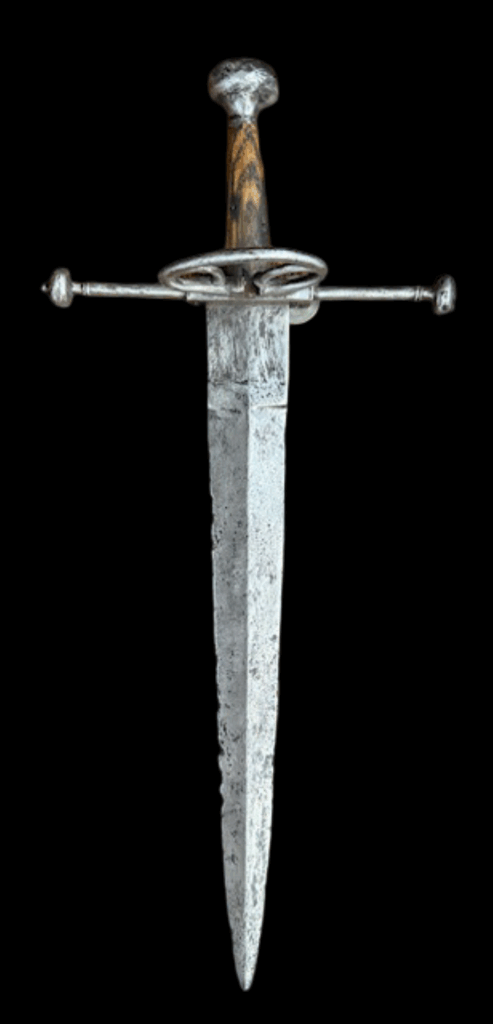
 2) AN ELEGANT LEFT-HAND DAGGER WITH HORIZONTAL ROPING  CIRCA 1580: Superb condition. This dagger is much more impressive in person than in pictures.
Description: Superbly constructed with a hilt decorated with horizontal fluting.  A Norman pommel # 15. The pommel with a slightly extended final point, possibly original wooden grip with wire wrapping and ferrules at opposite ends of the grip, long broad blade of stiff diamond-shaped tapering to an acute tip with no pitting, a medial ridge running from the tip to the square quillon block. An iron downward-turning guard expanding at the tips into the shape and decoration of the pommel. The dagger is in very good condition.
Discussion: In the past, swords were thicker, heavier, and stronger because opponents on the battlefield used armor. Because the rapier and left-hand dagger were civilian implements of defense with no armor involved, the sword could be much lighter and wielded more effectively with one hand. This lighter sword was the catalyst to the development of the left hand dagger.

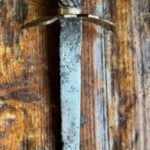
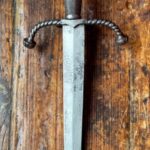
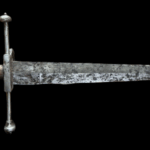
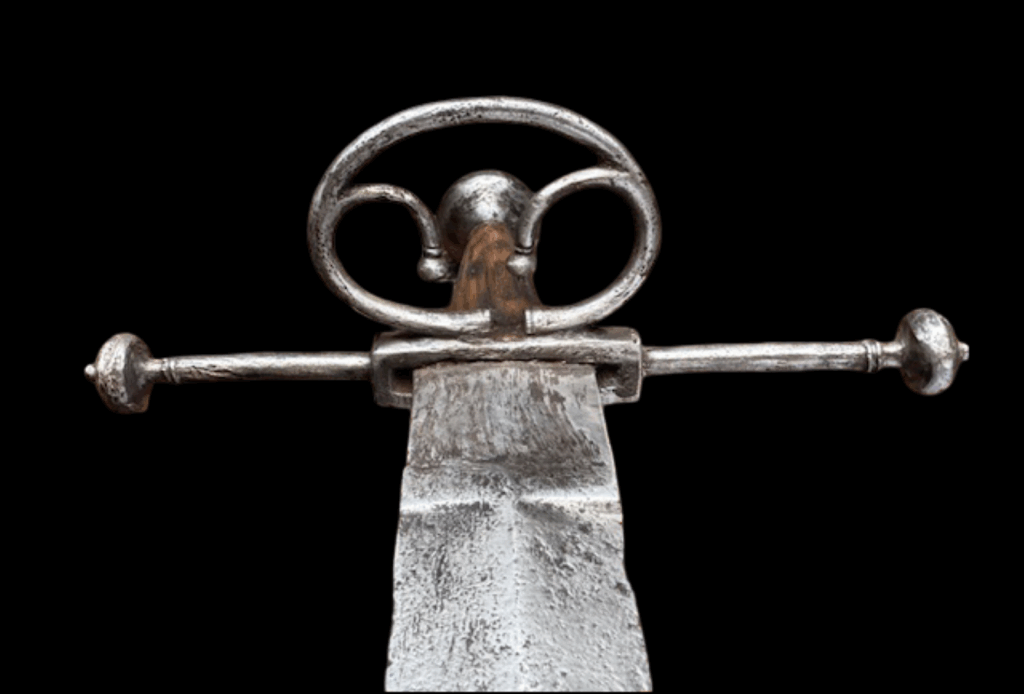
3) SAXON LEFT-HAND DAGGER CIRCA 1600: Massive thick with superb construction.

Discussion: The word opulence is defined as great wealth or luxuriousness. For opulence in the late Renaissance, look no further than the Armory of the Electors of Saxony in Dresden, Germany. With great wealth since the 12th century from mining silver, salt, and other metals such as bismuth, cobalt, copper, iron, gold, nickel, tin, and metalworking, they spared no expense on tournaments, social functions, and, above all, with the elite aristocratic members of the Trabantenleibgarde. The Trabantengarde was a light cavalry unit that served as the personal guard of the prince-electors. They were dressed in black doublets and yellow trunk hose and equipped with the period’s finest opulent arms and armor.
Description: Superbly constructed with a  Norman pommel #  56. The pommel with a slightly extended final point, possibly original wooden grip, long broad blade of stiff diamond-shaped tapering to an acute tip, a medial ridge running from the tip to the square recasso. An iron horizontal guard expanding at the tips into the shape of the pommel.
Condition: The dagger is in good condition. Possibly a tomb find.
Provenance: From a fine European collection.
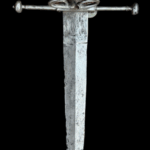
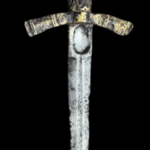
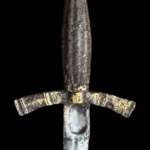
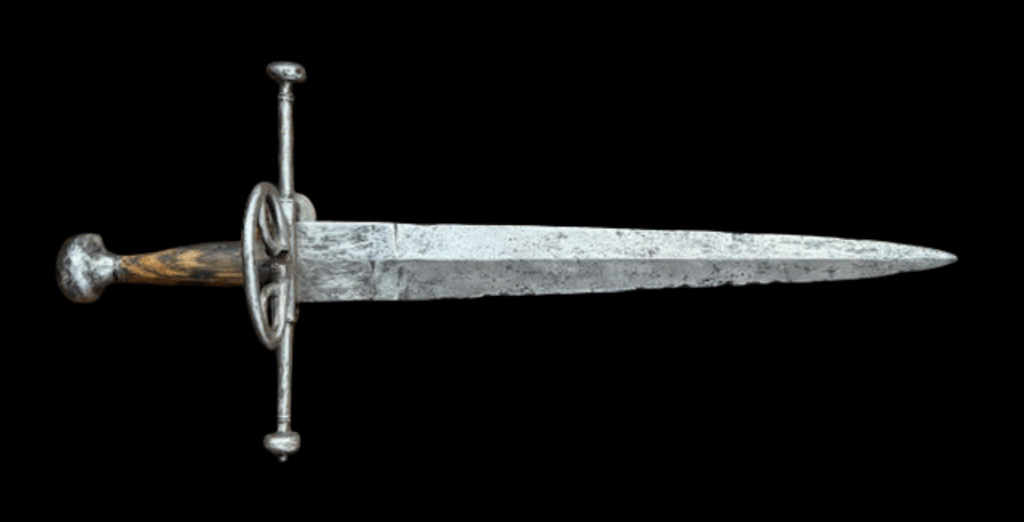
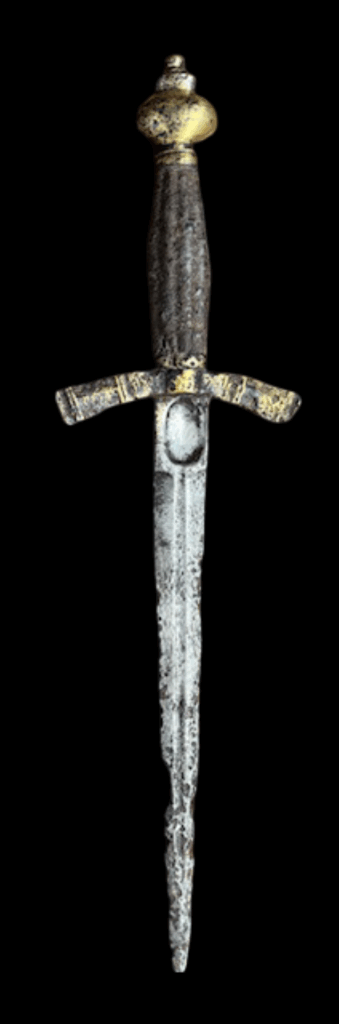
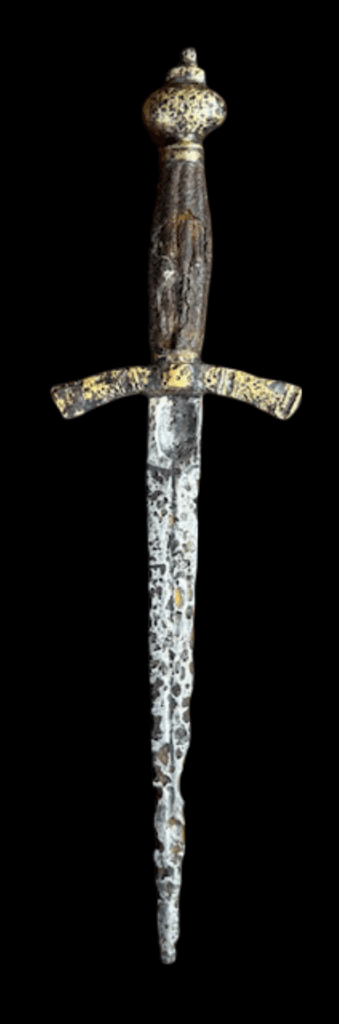
4) EARLY GILDED AND CHISELED FRENCH LEFT-HAND DAGGER CIRCA  1560: 
Discussion: A very elegant ground find in good condition. Yes, it’s not mint, but if it were, it would be in a museum and not in the collectors market. If in the collectors market, it would sell for 4 to 5 times the price it’s being offered at! I like ground finds. Ground finds have a certain mystique about them and sell for much less than they should.
Description: Constructed with a Norman pommel 72 and downward-turning flat chiseled decorated quillons that expand at the tips, a long, broad blade of stiff diamond-shaped (corroded but strong)  tapering to an acute tip, a fuller running from the tip to the square recasso, ricasso with a thumb rest. Original grip with ferrules.

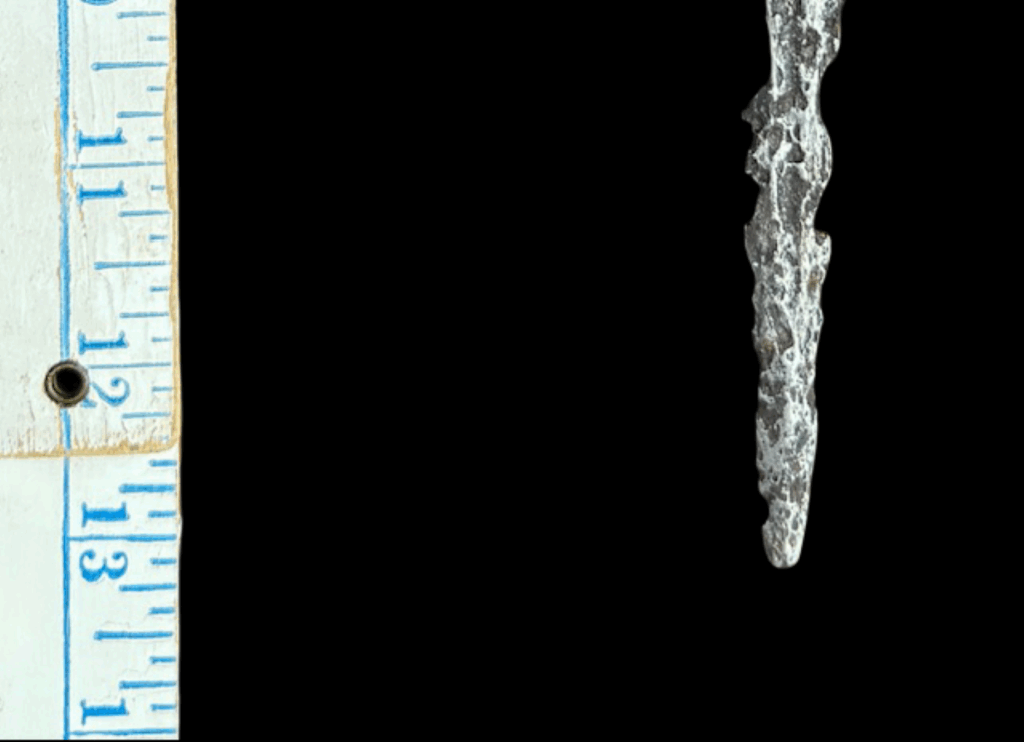
Length: Approximately 13.5 inches.

Condition: Has retained about 90% of its gilding on the hilt. Blade corroded but strong.


PHP Code Snippets Powered By : XYZScripts.com
JOIN OUR MAILING LIST
Form is not available. Please visit our contact page.
X
Sign Up