
2101 Antique Sword
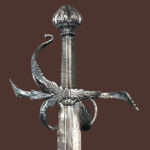
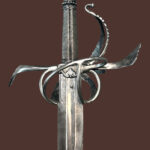
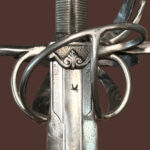
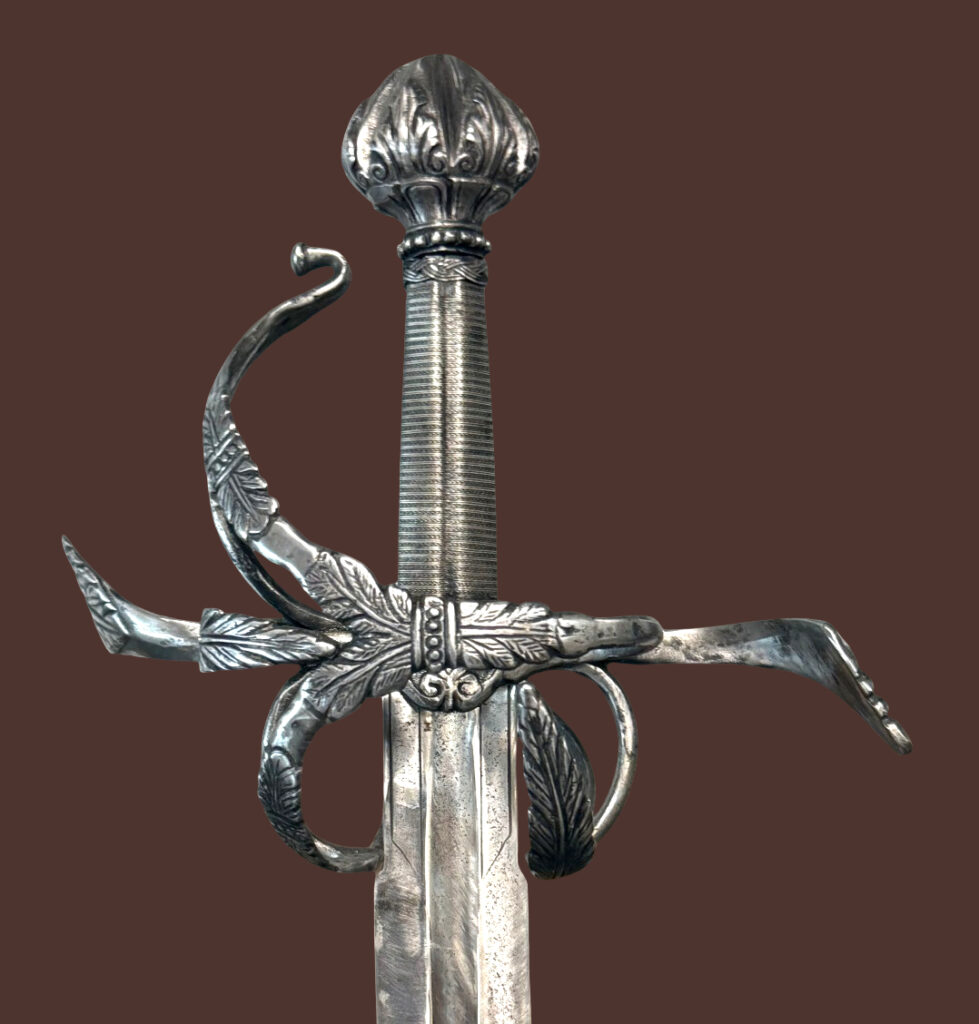
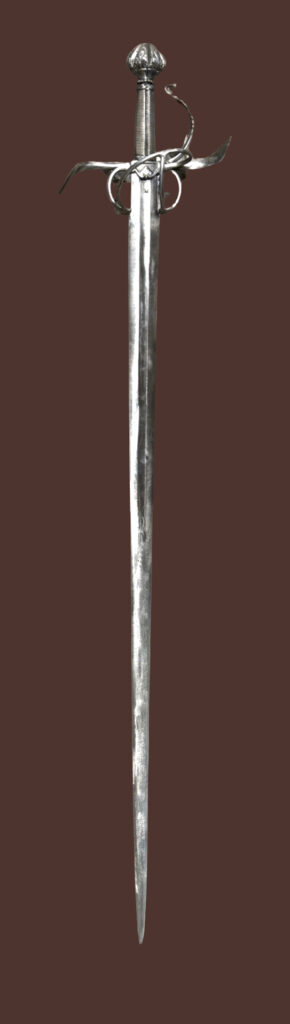
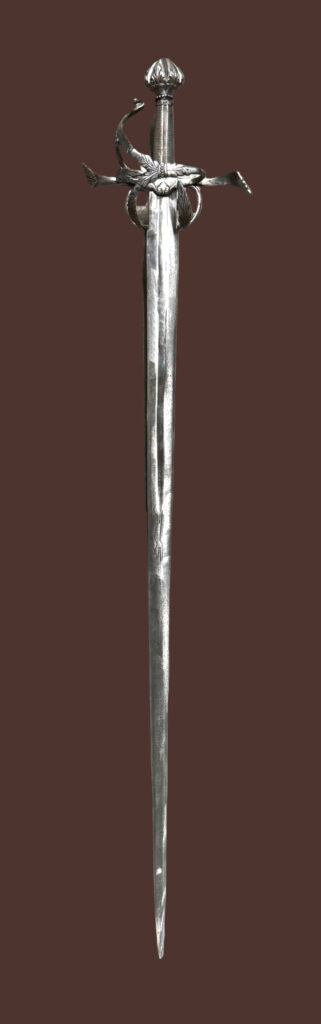
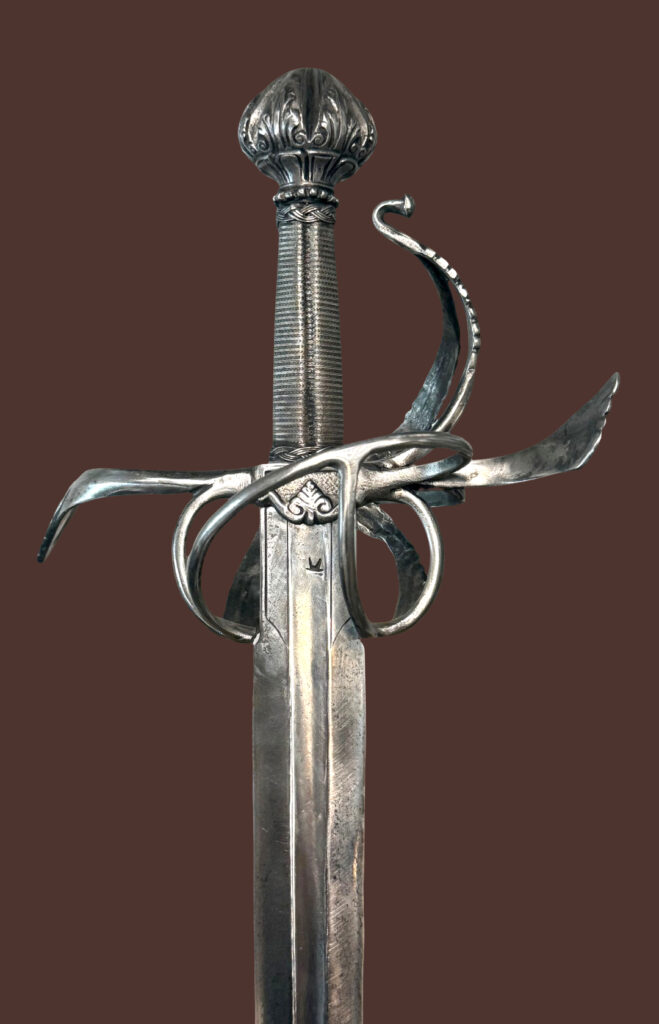
2101) HIGHLY DECORATED GERMAN SWEPT HILT BROAD-BLADE RAPIER CIRCA 1560:
Introduction: A highly ornate German swept hilt characterized by its sculptural, organic relief carvings. Classified as Norman type 38. This is an exceptional rapier. A highly expensive, ornate rapier such as this one was the equivalent of a person in our day and age making a fashion or opulence statement by wearing very expensive jewelry, such as a Rolex or Audemars Piguet watch. High fashion was an essential status and power symbol during the late Middle Ages and the Renaissance. High fashion mattered especially to the mega-wealthy, who wanted to outdo rivals, neighbors, and peers in the fashion arena. Not all wars were fought on the battlefield with swords, lances, and armor. A non-bloody war was in the fashion and status arena. Fashion also extended deeply to Arms and Armor. The phrase… “keeping up with the Joneses” … is not a new 20th-century concept.
This sword typology was used as early as 1550 and onward. The earliest known illustration of this typology appears in a portrait titled “Knight of St James” with an attribution to Sebastiano del Piomo circa 1550 (Berlin-Dahlem, Gemäldegalerie, Cat # 259a). Some slight re-wielding expertly done to the hilt, which is not surprising since rapiers like these were weapons of war and guard duty, unlike narrow-bladed rapiers used for civilian use.
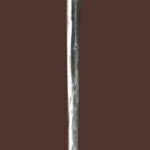
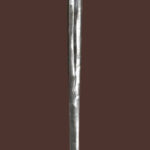
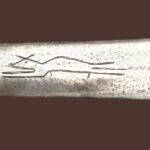
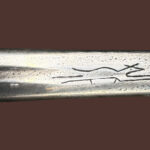
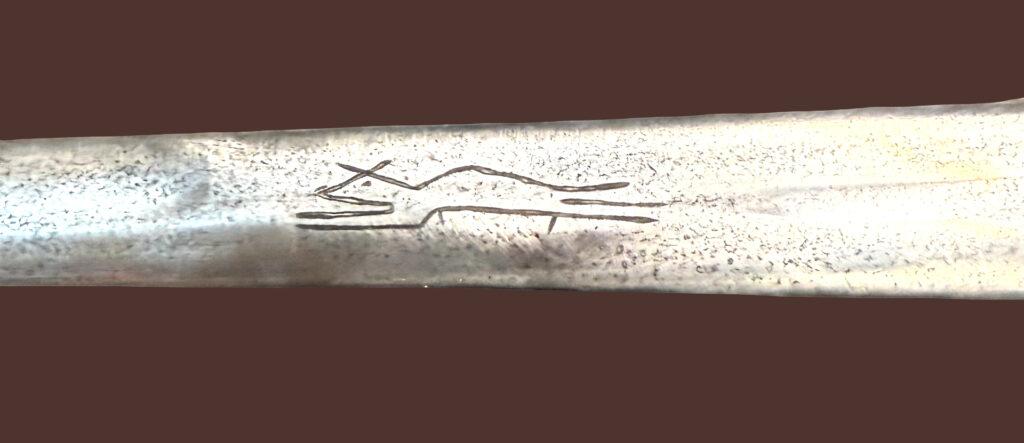
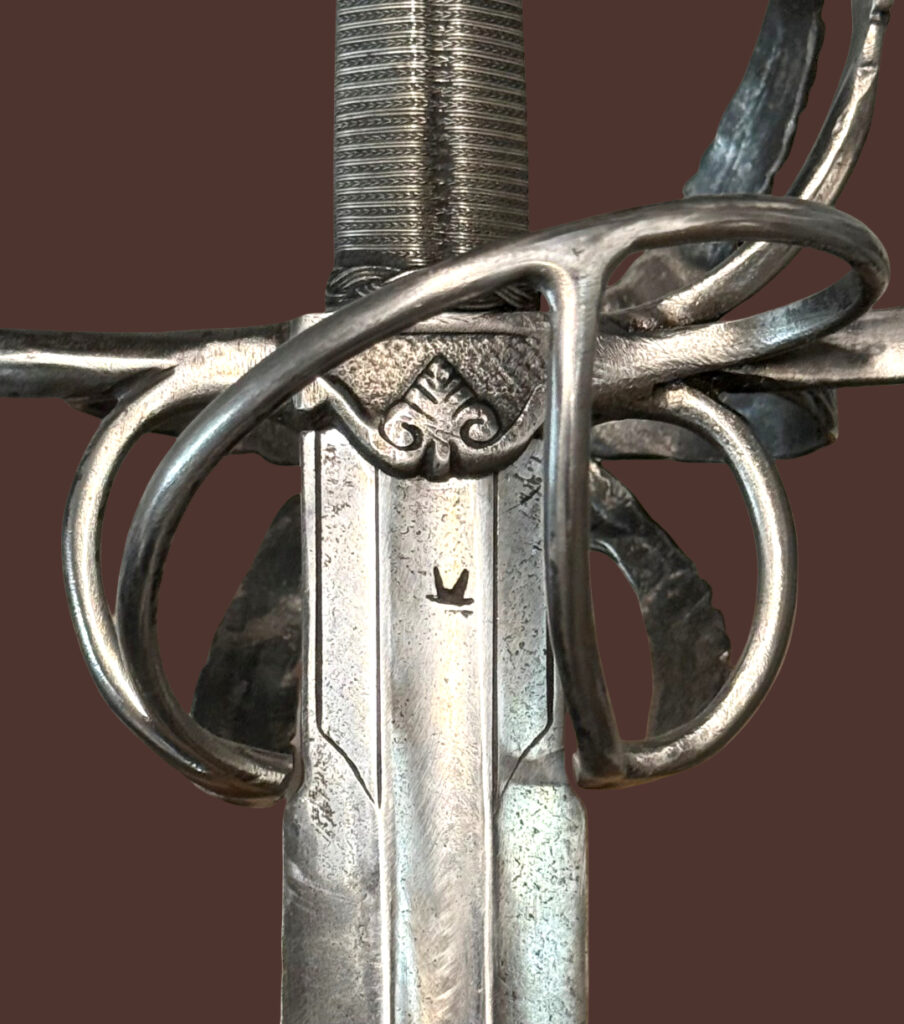
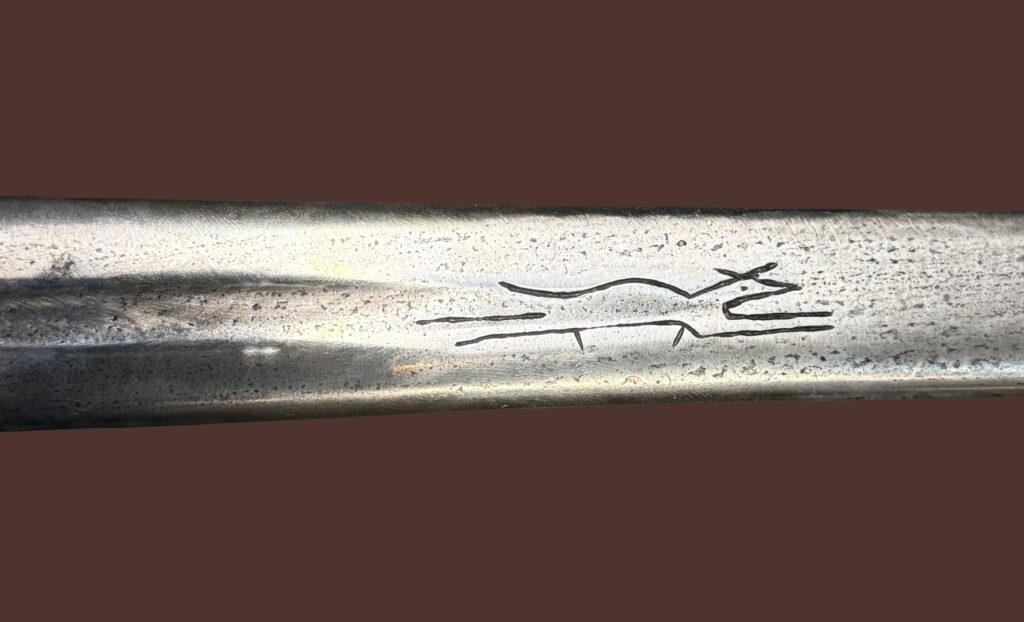
Description: Classified as a Norman type 38. Constructed with a double-edged, wide blade of flattened hexagonal sections tapering to a sharp point; a wide fuller about a third the length of the blade; an unknown maker’s mark at the ricasso; and a Passau wolf on the blade. The pommel is a prominent Norman type 50, deeply chiseled with acanthus leaves or localized petal-like fluting radiating outwards from the peen block, en suite with the botanical theme of the guard. The grip is tightly wrapped in alternating strands of fine, twisted wire with Turk’s heads. The quillon block is decorated with a prominent acanthus leaf extending down toward the blade’s ricasso. The crossguard features an elongated, expanding, recurved quillon at the tip. One branch curves gracefully toward the pommel to form a knuckle bow, while the opposite side extends outward and terminates in an asymmetric, flattened finial carved like a folding leaf. Every major guard branch, loop, and ring is entirely sculpted to resemble long, overlapping acanthus or feather-like. The chiseled work highlights distinct midribs, detailed fine veining, and serrated or scalloped outer edges. The hilt uses an intricate network of swept bars to form protective finger loops and side rings. These loop guards cross symmetrically below the quillon block, protecting the hand while echoing the botanical theme.
Condition: Superb, could be in a museum.
Length: 45 inches.
Discussion: In an age lacking effective policing, the private citizen was forced to protect himself from society’s criminal dregs. The weapon of choice was the rapier from the middle of the 16th to the end of the 17th century. The rapier is a simple yet highly effective sword against non-armored opponents. The rapier was primarily a thrusting weapon that could inflict serious injury to an adversary’s vital organs with minimal effort. It was also an exceptional slashing and cutting weapon; however, the slash was not as lethal as the thrust. The slash was used more as a feint to set up a finishing thrust. The slash was also a dire warning to a would-be assailant of the horrors to quickly follow if he chose not to acquiesce.
Because fencing is more of a thrusting art, it became commonplace throughout Europe to have as long a blade as possible to obtain an advantage. This extravagance in length reached the point that municipalities passed statutes regarding the allowable lengths of blades. Those in violation had the misfortune of having their rapier‚ blades cropped at the tip at the city gate to comply. One example of these statutes is from an English Royal Proclamation on March 17, 1557. The French adopted the phrase “espee rapiere” by 1475, which was later shortened to simply “rapiere.” The English, in 1505, spelled it”rappyer.” The Giles Duwes English/ French dictionary of 1532/3 adopted the rapier definition as “Spannyshe sworde”.
By 1550, the term rapier had been adopted to describe a slender, sharply pointed sword designed for thrusting, cutting, and slashing attacks. The rapier now consisted of a hilt protected by a handguard. The Earliest Illustration of this sword Typology is in a 1588 portrait of John Shirley, currently housed in the Metropolitan Museum of Art (#51.194.2). Also illustrated in a portrait of Luccio Foppa circa 1585 by Giovani Antonio Figino.
Comparable: Odescalchi Museum Inv # 1578……. Museo Stibbert Florence, Cat 444.
Provenance: From an American collection.
Conclusion: An exceptional rapier in superb condition. I am surprised that a museum did not acquire this sword 100 years ago. They seldom come this nice. Priced to sell immediately. Don’t wait; this one will not last, and it’s the only one I have!!!*
This is a rare opportunity. ACT-NOW!!!
All my items come with the following:
–Free shipping.
–10-day review period.
–Certificate of Authenticity.
– Free autographed copy of my book if you do not have one.
– In the event of an international shipment, we will help assign the lowest correct Customs tariffs, so you pay the least as little as 5% or even nothing.
I believe you will be very pleased. ACT NOW!!!*