2053 Antique Sword
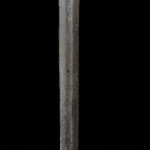
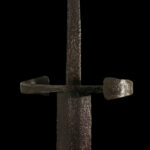
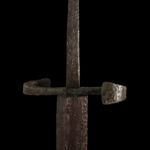
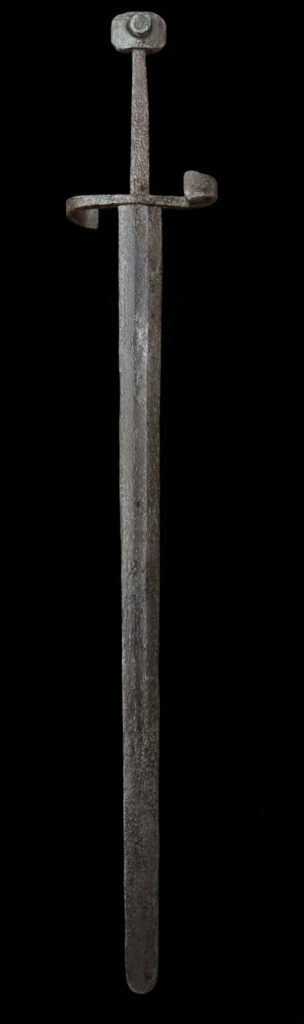
2053) A VERY FINE AND RARE VENETIAN SCHIAVONESCA BASTARD SWORD, CIRCA 1475:
Introduction: This distinct style of Sciavonesca broadsword originated in the late 14th century and became typologically uniform across the Republic of Venice and the Kingdom of Hungary by the late 15th century. The sword under discussion is thick and heavy and is in very good condition. This sword is NOT a ground find. From its exceptional condition it could be a tomb find.
Or possibly from:
– Centuries in an armory.
– Church storage.
– Castle storage.
– Manor-house storage.
– Monastery.
– Old ancestral collection.
This typology of swords are intimately tied to the Schiavoni, the elite Balkan Slavic mercenaries (primarily Croats and Serbs) hired by the Doge of Venice to defend maritime trade networks, Adriatic ports, and the Ducal Palace. Their preferred native sidearms blended Byzantine, Balkan, and Italian metallurgy into a brutal, highly balanced fighting weapon. Excellent companion groupings of these specific S-guard variants are heavily preserved in the Palazzo Ducale Armory in Venice
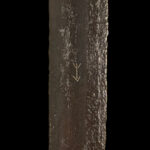
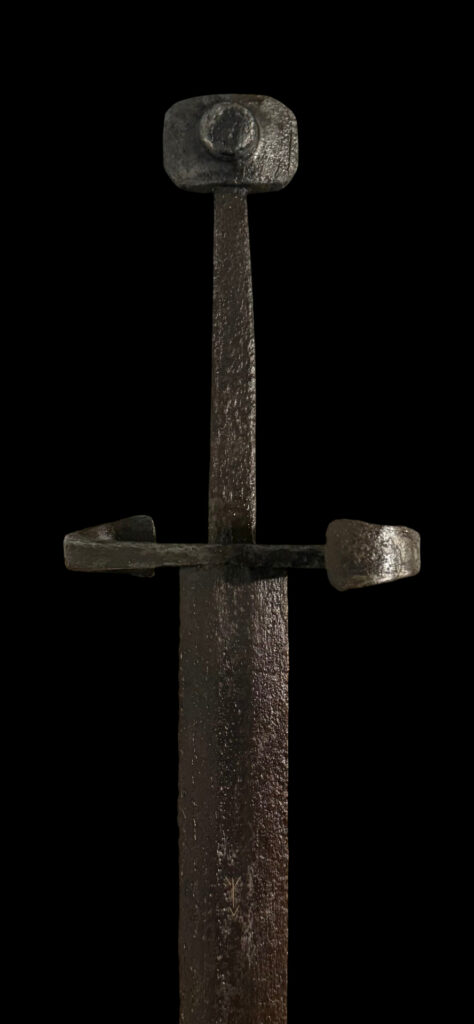
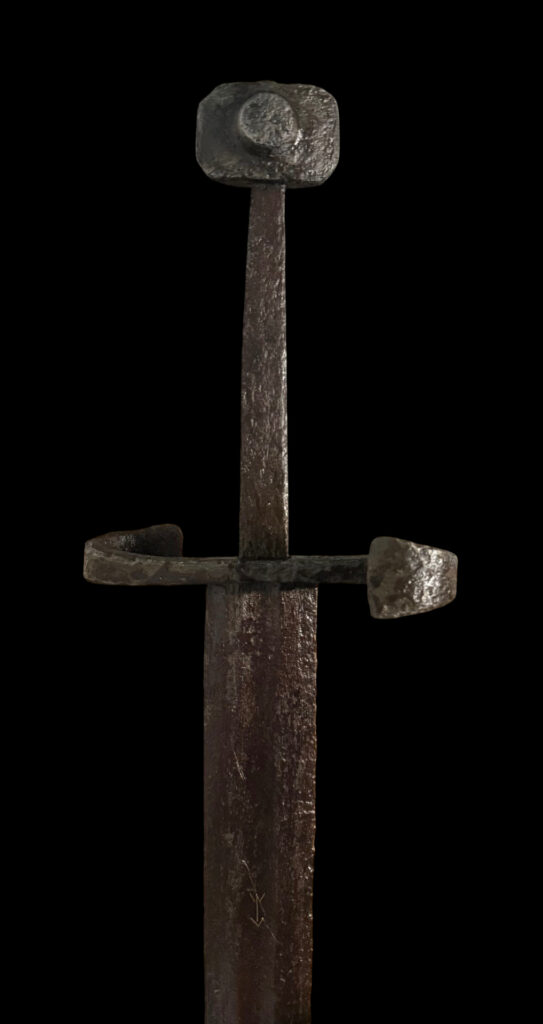
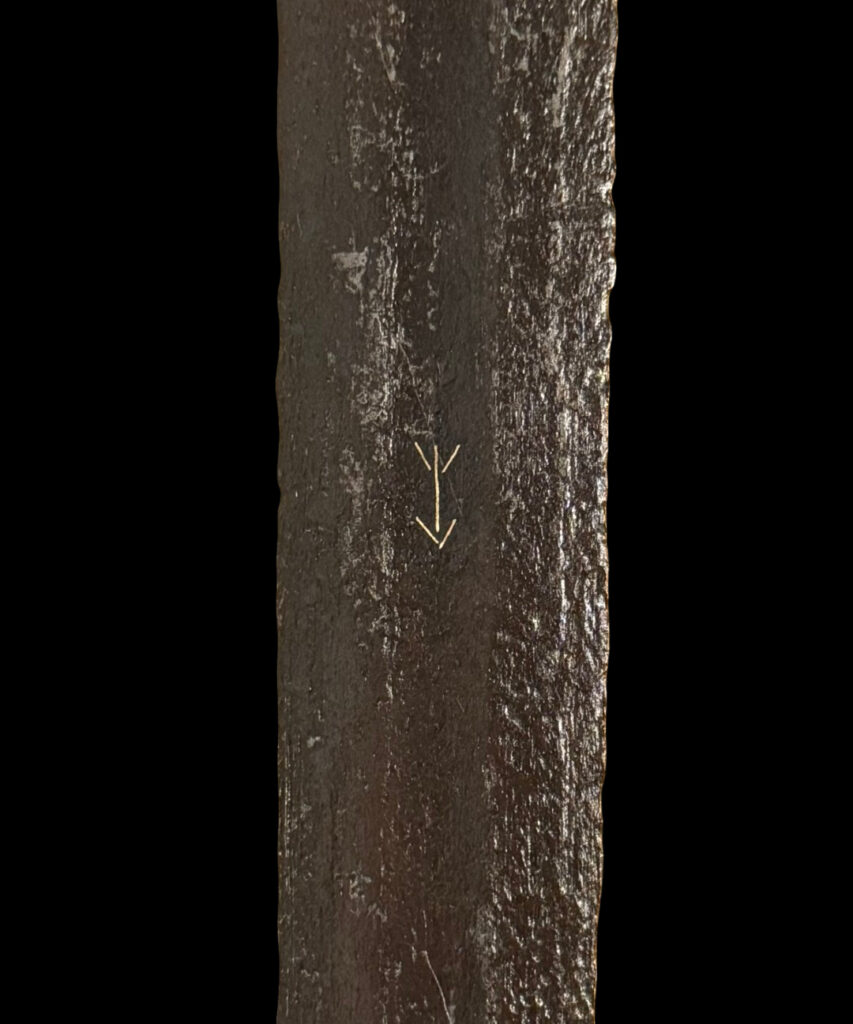
Description: Constructed with a recurved, horizontally undulating quillons are tightly curled at the ends, which is the definitive visual trait of the schiavonesca family. This design helped trap or deflect an opponent’s blade. The square, blocky iron pommel features a pronounced central raised boss. This represents the direct 15th-century precursor to the famous stylized “cat’s head” (katzenkopfknauf) pommels seen on later Venetian basket-hilted schiavona swords. The broad, robust double-edged blade is designed heavily for cutting. It exhibits a broad central plane, tapering gradually toward the point. The blade features a distinct, finely engraved arrow-like or “twig” mark inlaid with latten or copper alloy. In Italian arms connoisseurship, this style of minimalist linear punch or inlay is often cataloged as a Marca a Mosca (fly/twig mark) or regional standard mark. This specific variation—a vertical line crossed by angled “fletching” lines and an open arrowhead—is heavily documented on 15th and early 16th-century blades forged in the Veneto-Brescian region (Brescia and Belluno).
Rather than identifying an individual smith, it frequently indicated that the blade passed rigorous guild inspection or met the quality controls of a North Italian maritime arsenal.
Condition: Very good. Having a beautiful deep brown chocolate colored patina with light pitting for a sword of this age.
Approximate Length: 42.75 inches.
Provenance: From a fine Venetian collection.
Comparables: Found throughout Italian museums many not in as good condition.
Discussion: A bastard (or hand and a half sword as later called by Victorian collectors or Anderthalbhander in German) is a combination of a short two-handed sword that can be wielded like a one-handed sword. It cuts and thrusts with a broad or long double-edged blade. Additional power can be employed by using (A) the pommel and the related lower area of the hilt below the pommel as a grip for a two-hand strike in order to increase impact and penetration.
The term bastard sword is first recorded in France during a duel in the 17th century. In Marc de Vulson’s 17th-century treatise “Vray Theatre d’Honneur”, he describes the weapons used in a duel fought before King Henry II of France in 1549 as follows: Deux epees batardes pouvant servir a une main ou a deux (Two bastard swords that can be used with one hand or two). I prefer the term “bastard sword” since this is the original term and not one concocted by the Victorians. It’s interesting to note that the ballock dagger (a vulgar word for testicles) was renamed the kidney dagger around the same time. They first appeared circa 1250 until circa 1650. They were widely used in Germany and Switzerland, but more prevalent towards the end with the Central European Cavalry.
Hilts varied throughout their evolution. Until circa 1550, most hilts on German bastard swords were cruciform in shape, with some having S-shaped guards. After circa 1550, some hilts became more elaborate. From approximately 1550, Swiss bastard sword hilts featured recurved quillons, knuckle guards, and ring guards. Blades were slightly curved, having developed somewhat from the Swiss saber (Schweizersabel). Prior to c1250 and the development of the bastard sword, swords were designed as arming swords with their use limited to one-handed use. Since they were knightly weapons, they were frequently used from horseback.
Sword length during this period varied from approximately 35 to 40 inches; after c1250, length increased to approximately 45 to 55 inches.
So why did it take until the early 1300s for the bastard sword to flourish?
Primarily, there are two significant reasons:
1) For the same reason, full metal defensive armor and two-handed swords did not develop until the same period. As furnaces grew larger in medieval Europe, billets of steel —solid lengths of steel —increased in size accordingly. With bigger billets, swords could now be made with fewer (but larger) billets of steel. Eventually reaching the apex of one billet per sword. Larger furnaces generally meant higher temperatures, better steel, faster production, and probably lower manufacturing costs on a large scale.
2) As the master armorer evolved defensive armor, his counterpart, the swordsmith, did the same with larger and more specialized swords of superior quality and design. This was the weapons race of its day.
Conclusion: This is a thick, strong, heavy sword with tremendous provenance. The stories this sword could tell. This could be the centerpiece of any collection or proudly displayed in any museum.
ACT-NOW and avoid disappointment!
All my items come with the following:
–Free shipping.
–10-day review period.
–Certificate of Authenticity.
–Autographed copy of my book.
– In the event of an international shipment, we will help assign the lowest correct Customs tariff, so you pay the least.