2047 Medieval Sword
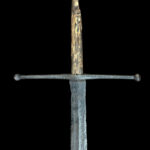
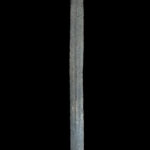
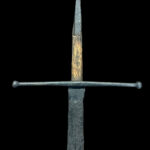
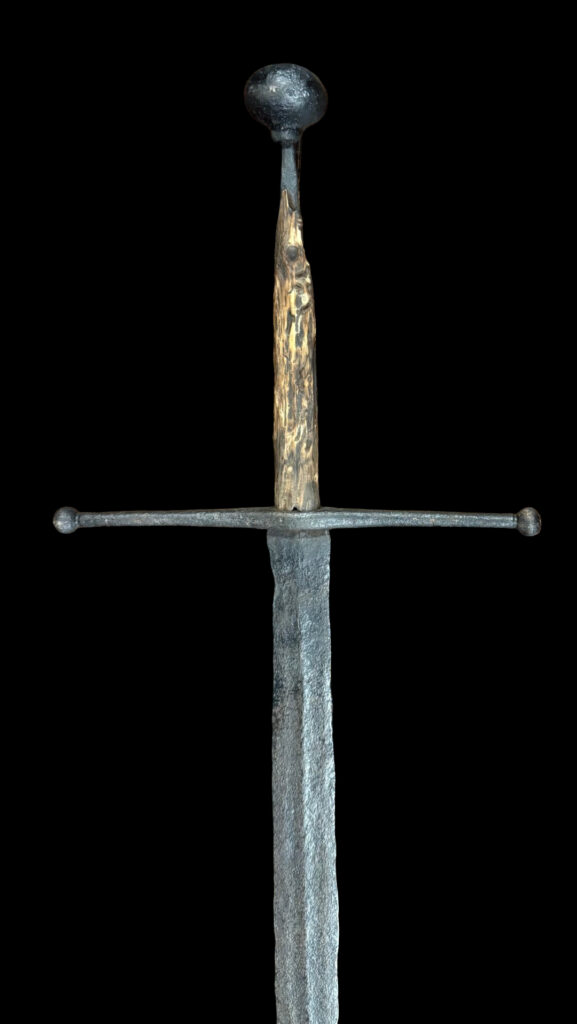
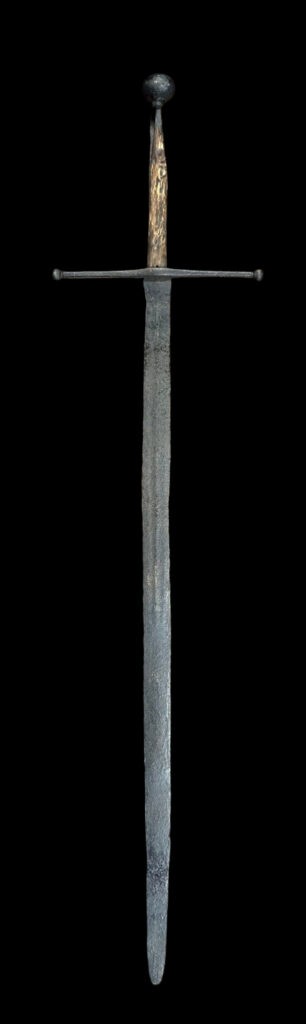
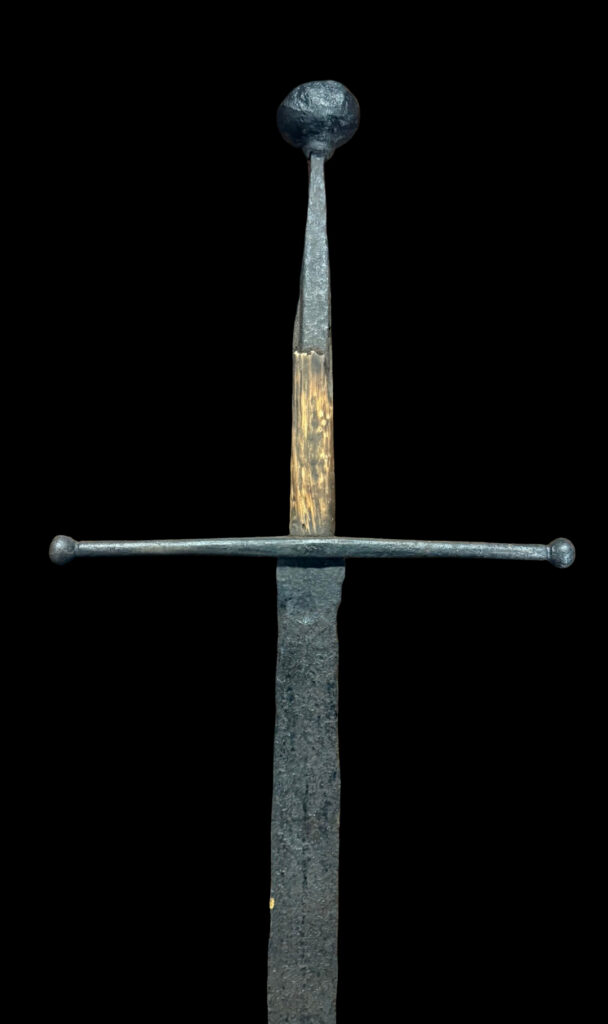
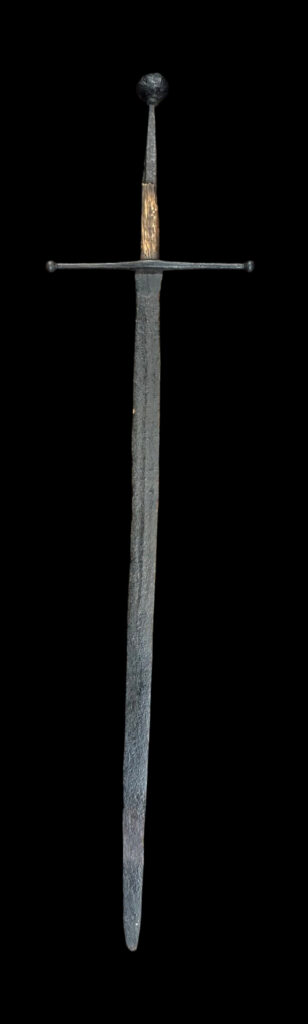
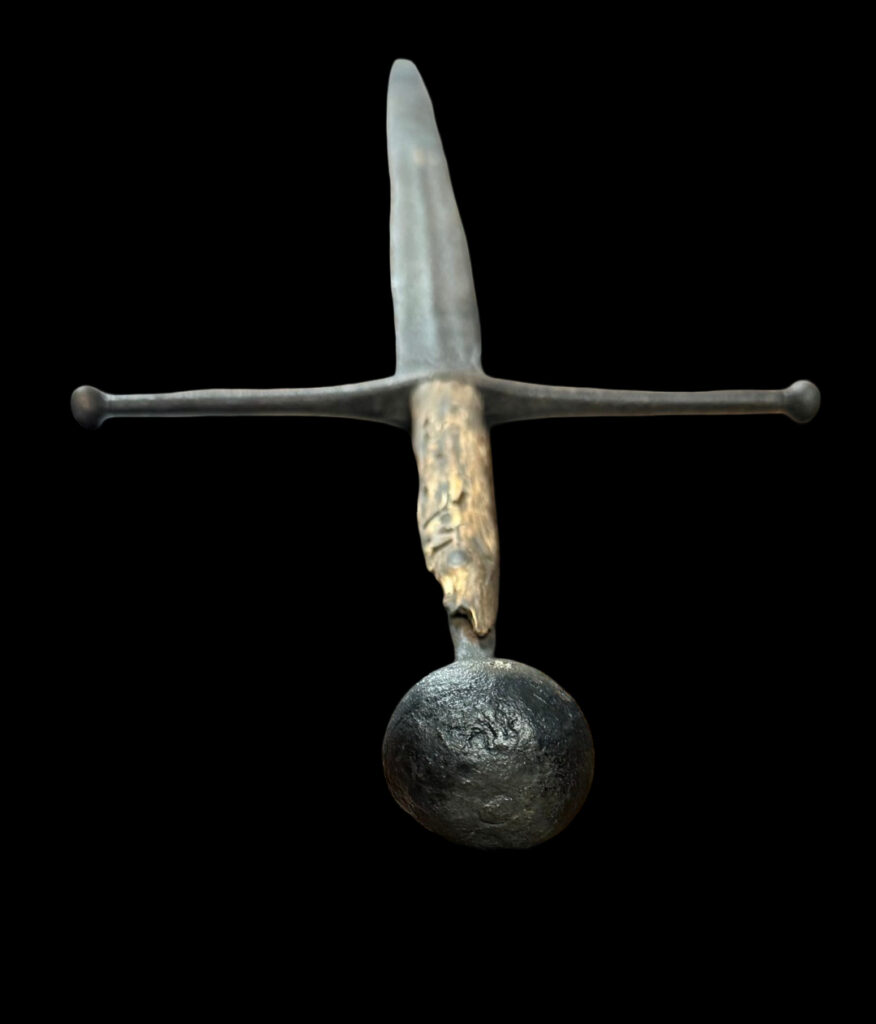
2047) A RARE MASSIVE KNIGHTLY TWO-HAND SWORD, TYPE XVIIIa CIRCA 1380 WITH WOODEN GRIPS:
Introduction: Nothing says Knighthood more than a cruciform-shaped sword from the golden age of chivalry. Today, we associate the sword with the knight of noble birth. That association is essentially correct since swords are weapons of war, and only knights could carry them in times of peace. In some towns, even the nobility could not carry a sword. Merchants and townspeople often carried daggers but not swords.
From its superb patina, this sword is almost certainly a river find. It’s a superb example of a highly sought-after sword with a strong feudal past that can be the center of any collection. It’s very reasonably priced for an immediate sale.
Two-hand swords did not develop until about the same period as plate armor. As furnaces got bigger in Medieval Europe, steel billets (solid blocks of steel) accordingly increased in size. With bigger billets, swords could now be made with fewer (but larger) homogeneous steel billets, eventually reaching the peak of one billet per sword. Larger furnaces generally meant higher temperatures, which, combined with homogeneous billets, would result in better steel, steel strong enough to create bigger, stronger blades.
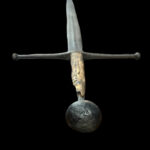
Description: This Oakeshott type XVIIIa two hand sword is constructed with an Oakeshott Style 2 guard with circular tips, retaining slightly over half of the original wooden grips, an Oakeshott Style R Spherical pommel, a wide, flat, double-edged blade with remnants of a medial ridge tapering to a sharp point. From its superb chocolate brown patina, this sword is almost certainly a river find.
Condition: Very Good.
Length: Approximately 48.5 inches.
Provenance: From a private European collection that started after WWII.
Discussion: The Subtype XVIIIa has a working life of 1380–1510. However, based on the hilt, the date of this sword can be narrowed down to 1380-1440. The Subgroup Type XV111a is longer and slenderer than Type XVIII. Typically, swords of this type are two-handed or hand-and-a-half swords.
The blade has a medial ridge along its entire length of the blade. A fuller may or may not be present, but if it is, it is narrow and relatively short, about a third of the blade length. Although slimmer than a Type XVIII, the Type XVIIIa is still the epitome of both slashing and thrusting. These swords are elegant, and some exceptional examples have survived (see pages 251 and 281 in my book).
To understand the development of the Medieval and Renaissance sword, there are idiosyncrasies, facts, and misconceptions you may need to learn or clarify.
1)Swords, in general, were seldom made by a single swordsmith, even if his mark or signature appeared on it: Swords were mass-produced in centers such as Passau in Lower Bavaria and Solingen in a city near North Rhine-Westphalia. Many blades were made exclusively for export to other countries.
2) Swords with good blades (a valuable commodity) were passed down and re-hilted. The working life of a sword/blade could be for several generations. Therefore, you could have a blade with a later hilt type.
3) The catalyst of sword design and evolution was dictated primarily by changes in warfare strategy, civilian combat, and defensive armor worn by both civilians and the military. It is no coincidence that by circa 1420, when full plate armor was coming to fruition, the sword started to develop into a stronger thrusting weapon that could penetrate mail and find openings in armor (see “Chink in the Armor,” pages 83 and 214-215 in my book).
4) Most swords were made to be wielded with one hand and usually on horseback. A two-hand sword from this era is rare. Most blades were double-edged; however, some examples are single-edged. The balance of a sword was very important; it made it easier to wield, and the knight tired less because it felt lighter. The counterbalance to the weight of a blade is the pommel. The tang (see page 35 in my book) was usually covered with wood. The wood is covered with leather, wire, or cord. The wood is necessary because it increases the mass of the sword grip, thus making it easier to grip, strike harder, absorb vibrations, and fatigue less. Another critical function of the wood grip is to reinforce the guard by transferring the impact the guard (quillon) receives directly to the pommel (this is why guards are not welded to the blade).
Conclusion: This sword is a gem! It’s very reasonably priced for a quick sale, and it has everything a collector or even many museums are looking for in a Medieval sword: condition… original grips…rare typology… and a certain mystique that can only be associated with a Medieval sword from the time of Knighthood- the stories this sword could tell.
ACT NOW, this sword is priced to sell immediately. Bargain swords like this seldom come around, and if you wait, you will be disappointed because it will sell!!!*
Contact Me to Get the Latest Lowest Price Possible from The Owner*
All my items come with the following:
–Free shipping.
–10-day review period.
–Certificate of Authenticity.
–Autographed copy of my book, if you do not have one.
– If it’s a helmet, a custom wood stand.
– In the event of an international shipment, we will help assign the lowest correct Customs tariff, so you pay as little as 5% or even nothing.
I believe you will be very pleased.