2119 Antique Helmet


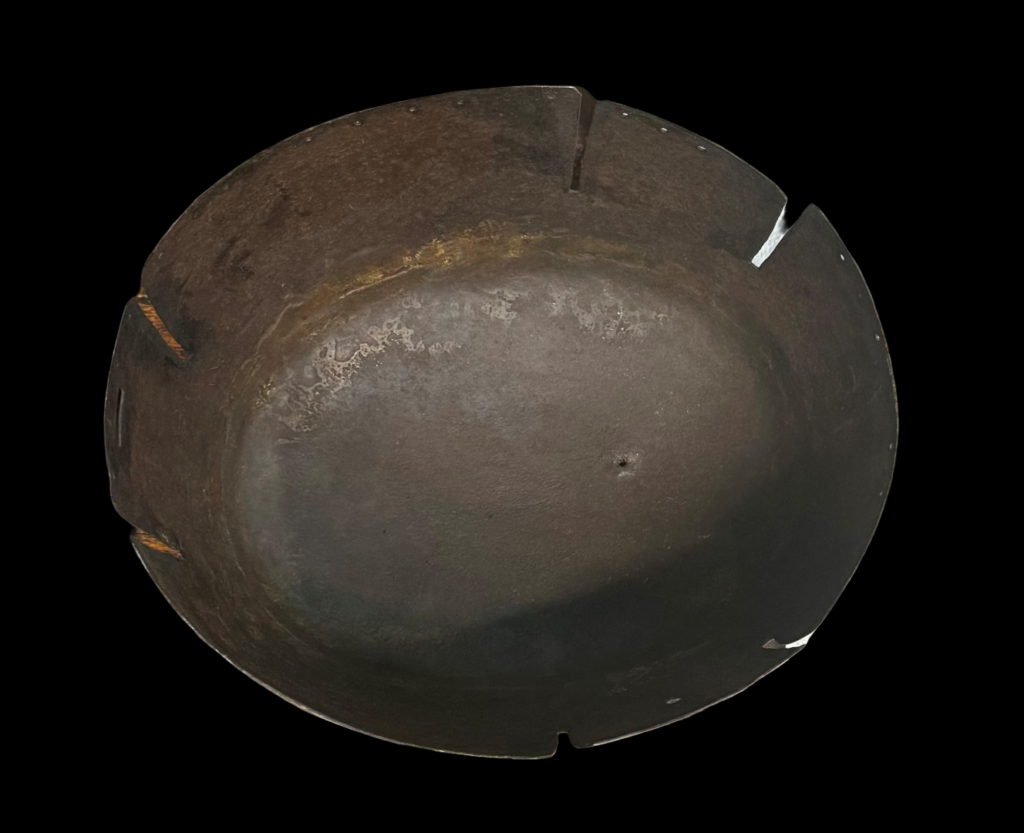

2119) A LARGE SKULL HELMET FROM THE TOWER OF LONDON CIRCA 1600:
Introduction: In the 1600s, musketeers primarily wore wide-brimmed cavalier hats in the first half of the century, which later evolved into tricorne hats by the late 1600s, both made predominantly from beaver or wool felt. So how did they protect their heads?
The helmet under discussion was worn, hidden under a hat, during the Renaissance to protect the wearer’s head from weapon attacks. It is called a “secret”. These unique helmets allowed both soldiers and civilians to maintain fashionable civilian styling while ensuring invisible protection. The “secrete” was popular during times of political instability or among those who had reason to fear assassination or street violence.
This helmet in particular has an exceptional provenance. It came from the Tower of London! Here’s the story; you may have read it on page 28 in my book. It involves a dirty little secret that has remained deeply buried for many years. It involves two very prestigious museums. The first is the Museum of Artillery, housed in the Rotunda, Woolwich Common, in Southeast London. If you bought Arms and Armor from Peter Dale Ltd. in London (no longer in business) in the late 80s or early 90s, you might have acquired pieces from the Tower of London (Royal Collection), and the provenance should be preserved for posterity.
Almost all museums sell items they no longer want at auction, usually to raise funds. Deaccessions need to be arm’s-length transactions. As a result, museums almost always use an international auction house to prevent favoritism or behind-the-scenes skullduggery.
Although the Rotunda Museum formerly contained a variety of military equipment taken as souvenirs or trophies from all over the world by British artillery officers, the trophies of Arms and Armor that decorated its walls were largely derived from the national arsenal at the Tower of London (Royal Collection)
In the 19th century, the Board of Ordnance, which was responsible for the maintenance of ancient arms forming part of the Tower of London’s collections, willingly lent for decorative purposes not only to other castles in Britain, such as Windsor and Edinburgh, but also to regimental messes, government offices, and even sites abroad, including ones in Argentina, Rhodesia, and the United States.
Roughly 32,000 pieces were involved. The Rotunda Museum was one of the Board’s largest borrowers. In 1927, however, as a result of the recommendation of the Cottesloe Committee concerning the rationalization of the country’s arms collections, much armor was sent from the Rotunda to the Tower in exchange for artillery.
Nevertheless, some armor remained at the Rotunda Woolwich (Royal Artillery Museum) until relatively recent times, mainly for display rather than didactic purposes. However, in the 1980s, the Board of Trustees at Woolwich decided to dispose of its armor
Normally this would have been done openly by auction. However, the Board was aware that the Tower would have legitimate claims on the greater part of its remaining inventory, so they chose to sell it secretly through the London dealer Peter Dale Ltd.
In the collections of the Rotunda, there were many good pieces, including elements of an important 17th-century royal armor belonging to a helmet still in the Tower Armories. It was depicted in a portrait of the 17th-century artist, Michael Wright. Two further groups of elements belonging to the same armor had already been sold by the Rotunda Museum to Peter Dales. Peter Dale’s observant manager was upset at the armor being split up. He, therefore, exposed the selling scheme to the Tower of London and offered to sell the pieces back to the Tower at a nominal price.
Description: Constructed in the shape of a form-fitting dome, from iron or steel. The rim has small pierced holes, which permit the wearer to sew the metal cap directly into the fabric lining of a felt hat or feather beret. Six vertical openings permit a snug fit to the head after the application of the lining and stuffing.
Approximate Dimensions: 8.75 x 7.5 x 4.75 inches.
Condition: Very good with traces of original brazing.
Discussion: The secret evolved from a medieval helmet known as a cervelliere. While the medieval version was usually worn openly or under a chainmail coif on the battlefield, the Renaissance “secret” was explicitly modified for daily concealment. Skull caps cervelliere’s/ secrete’s were used in slightly different configurations over a 400-year period (see pages 48, 61, and 66 in my book). They appear in Hans Memling’s late 15th-century paintings, worn with quilted jacks. Landsknechts are still shown wearing them (see below, A Landsknecht officer circa 1550, wearing a skull cap from a woodcut by David de Necker) with “Almain rivets”.
English documents record skull caps being worn with jack right up to the end of the 16th century. They are often described as fabric-covered or worn with fabric bonnets. The holes are original and serve to attach a fabric covering. Such a simplistic helmet could only be improved in appearance with a covering.
The color of the covering could also have served to identify which unit the wearer belonged to. Skull caps were eventually replaced by the secret, which was worn under a hat (hence the expression “keep it under your hat”).
Conclusion: This is a very interesting piece that shows very well. It’s a lot of armor for a very little price. The story behind a secret alone is a superb conversation piece. This is a great item for any collector of Arms and Armor and just about everyone will think it’s a cervelliere from the 15th century. You are getting a lot for your money. ACT-NOW!!!
All my items come with the following:
–Free shipping.
–10-day review period.
–Certificate of Authenticity.
–Autographed copy of my book.
–In the event of an international shipment, we will help assign the lowest correct Customs tariff, so you pay the least.
I believe you will be very pleased. ACT-NOW!!!*