2013 Burgonet
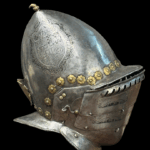
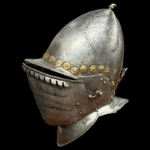
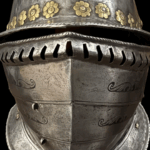
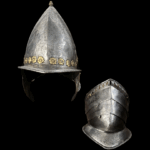
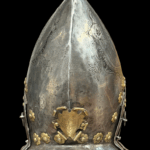

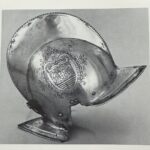



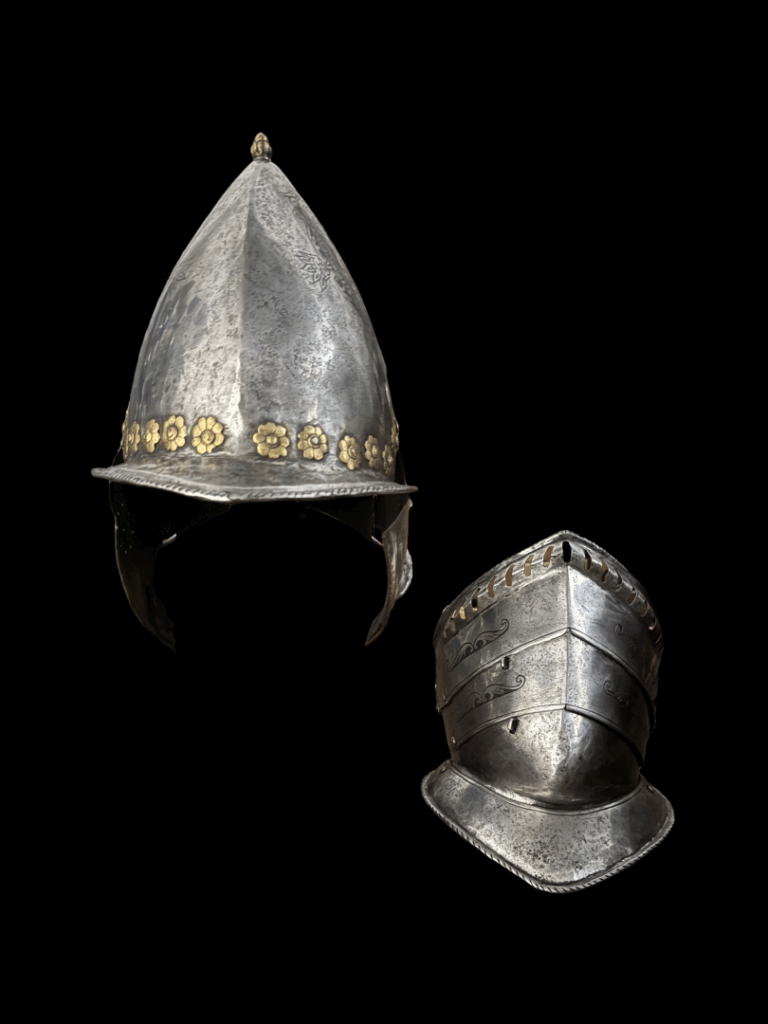


2013) IMPORTANT BURGONET WITH ORIGINAL BUFF FROM THE CIVIC GUARD OF CUNEO, ITALY, CIRCA 1590: Since inception over 400 years ago, this removable buff and burgonet have been together! It’s the only homogeneous burgonet and buff I have had in 35 years. This helmet is 100% original as the day it was made. You can now be the second permanent owner in over 400 years!
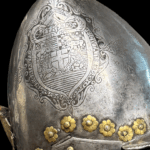
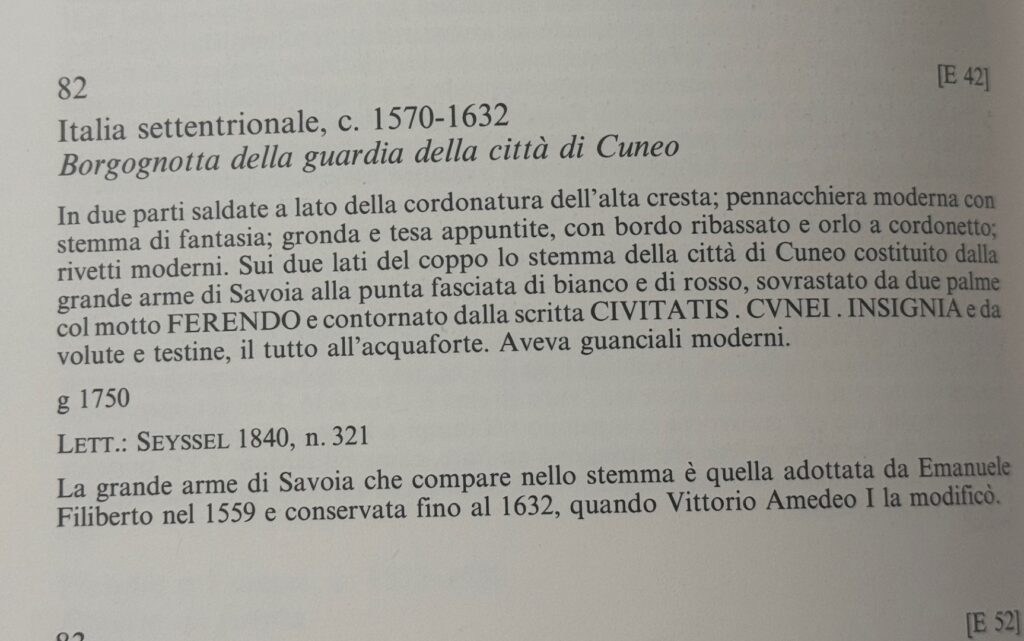
Description: Constructed with a massive conical skull of thick low carbon steel with a visor of a pointed peak at the front and pointed peak neck defense, a hooked finial at its apex, two cheek protectors with auditory holes held to the skull by hinges, decorated with roped inward turns at the edges with ogee molding en-suite, massive plumb holder, brass lining rivets with rosette washers over the visor, cheek pieces, and neck defense, three lamed buff with lower fourth neck defense held to the burgonet by hooks pressuring stationary rivet heads, top lame with 15 breath holes.Decorated with the Coat of Arms of Cuneo, which was adopted by Emanucie Filiberto in 1559 and preserved until 1632, when Vittorio Amedco modified it.
Discussion: Arms or armor that are homogeneous means the item is as original today as the day it was made by the original armorer. The odds of having a burgonet still with its removable original buff are exceptionally rare. This burgonet and buff have been kept together for 400 years during times of turbulence, war, apathy towards Arms and Armor, famine, and in a non-climate-controlled environment. This is truly a rare occurrence and a unique opportunity for the collector who only wants the best and the rarest.
In my opinion, the burgonet, along with a buff, is the finest defensive helmet of the Renaissance. The burgonet, sometimes called the Burgundian sallet, largely replaced the sallet in the 16th century. The burgonet is more of an early Renaissance helmet than a Medieval helmet. It looks more like a classical helmet than the direct descendant of the sallet. The burgonet was used primarily by the light cavalry and infantry. Little is known about the burgonet‚ development other than it was mutually developed (parallel development) by both Germany and Italy from the sallet. While the burgonet was preferred by the Germans over the morion, the Italians preferred the morion over the burgonet. In its infancy in France, the burgonet was called celada borgonona or “Burgundian sallet.In Spain, it was called salade a la Bourgogne (the same translation).
The burgonet is a tight-fitting, open-faced helmet with a comb and hemispherical shape, a visor peak to protect the wearer’s face, and a similar curved plate at the back of the neck. Hinged plates are found on some burgonets to protect the wearer’s cheeks. Combs, or a decorative ridge from brow to neck, were common. The comb helped reinforce the helmet and provided a space for embellishment on the armor of wealthy or noble soldiers. Other decorations, like rolled or embellished edges, were also common.
As early as 1520, many burgonets were equipped with a bevor, also known as a buff or buffe. The bevor/buff was designed to protect the face. On the bottom of the bevor/buff was a gorget to protect the neck. Most bevors were attached to the burgonet by:
(1) A leather strap with a buckle was situated around the lower curvature towards the bottom or edge.
(2) Hasps on each side.
(3) On Greenwich armor, two lugs are secured to the hasps.
(4) Some German bevors at the bottom are attached using catches and pins to the breastplate.
Bevors/buffs, in general, were constructed of articulated lames held in place by lugs attached to one another. – A falling bevor/buff permitted the knight to have fresh air by slightly lowering the overlapping lames it was constructed with.
Comparable: La Armería Real di Torino #82
Conclusion: This is probably the only homogeneous burgonet with buff I will ever have, or that will be offered to you. It also has the distinction of being used by the Civic Guard of Cuneo Italy. This is a rare item. If you have an eye for the rare and highly sought-after, I urge you to contact me as soon as possible; this gem will not last very long, especially si+
0nce it is priced to sell immediately. I believe you will be very pleased!!!*
All my items come with the following:
–Free shipping.
–10-day review period.
–Certificate of Authenticity.
–Free autographed copy of my book if you do not have one.